People want to be moved. When it comes to storytelling, conflict is what gives us the ability to move them. Filmmakers, as conductors of feeling, guide the audience on an emotional journey. The story is the vehicle that takes us, but without external conflict, it’s a car with no engine. But what is external conflict?
Today we’ll explore the meaning of external conflict and its significance in storytelling. We’ll also examine the relationship between internal and external conflict through the lens of filmmaker Derek Cianfrance (Roofman, Blue Valentine).
His films are pressure-cooker environments for characters facing profound battles both within and outside themselves. The kind of narrative that pulls hands to chests, leaves hearts racing, and creates cinematic experiences that linger long after the lights come up.
So if that’s what you’re after, jump in and buckle up!

What is an internal conflict and an external conflict?
Exploring External Conflict
First, let’s define external conflict.
Whether you’re writing your first screenplay or your fiftieth, you want to craft something with both depth and tension. External conflict not only drives your plot forward but also reveals your character’s inner life through how they respond to obstacles. But what is external conflict exactly? Let’s jump into an external conflict definition.
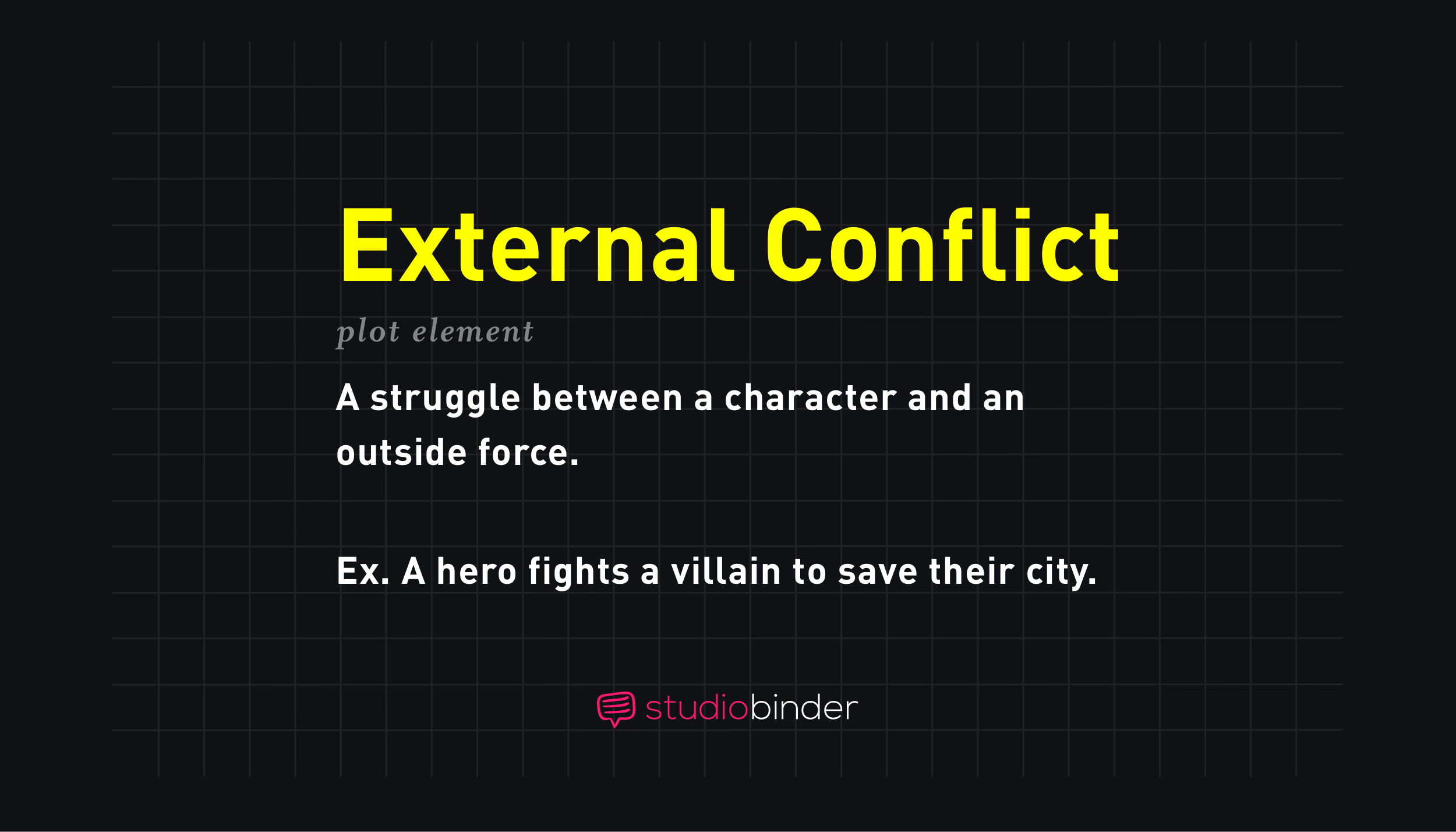
EXTERNAL CONFLICT DEFINITIONWhat is external conflict?External conflict occurs when a character battles a force outside themselves. Rooted in action and confrontation, this kind of conflict drives the plot, pushing characters to act, change, and grow. However, there are several forms of external conflict. |
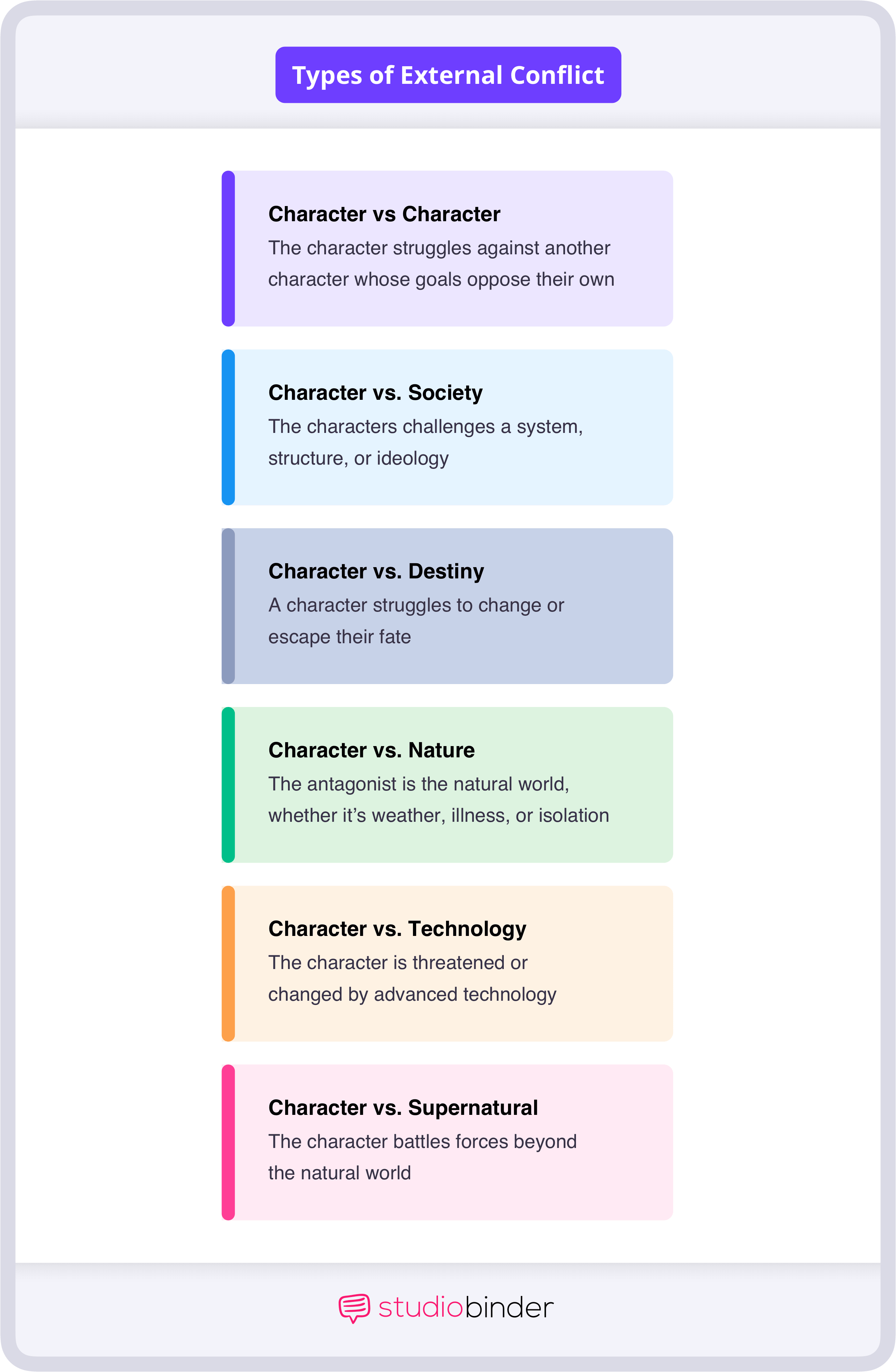
The six types of external conflict include:
- Character vs. Character
- Character vs. Society
- Character vs. Nature
- Character vs. Technology
- Character vs. Supernatural
- Character vs. Destiny
External Conflict Definition and Example
What is external conflict?
4 ways external conflict drives plot structure
With an external conflict definition out of the way, let’s go deeper. External conflict creates tension and provides the structural spine of a story. When a character faces an outside force opposing their goal, that pressure naturally shapes the narrative into a clear progression of escalating events.
Here’s how that progression typically unfolds with most forms of external conflict:
1. Inciting Incident
The inciting incident introduces the outside force that disrupts the protagonist’s normal world. This could be a villain’s arrival, a natural disaster, a societal rule, or any external barrier that blocks the character’s desire. With an external conflict defined by the inciting incident, the story gains direction because there is something concrete to fight against.
Check out the video below for a breakdown of how filmmakers use inciting incidents as the spark for compelling narratives.

Inciting incidents in film
2. Rising Action
As the protagonist attempts to overcome the obstacle, the opposition pushes back. Each setback increases the stakes, forcing the character into more difficult choices. The external conflict escalates through complications, reversals, and mounting pressure, driving the story forward scene by scene.
Escalation is key: every attempt to solve the problem should either fail or create a bigger problem. Without increasing external resistance, the plot loses momentum.
3. Climax
The climax is the ultimate face-off between the protagonist and the external force. This is where the central conflict reaches its highest intensity and the character must confront the obstacle directly. The outcome determines whether they achieve their goal or fail trying. Because the external conflict has been building throughout the narrative, the climax should feel earned and inevitable.
However, that doesn’t mean anticlimax, which is the opposite of climax, can't work either. Check out the video below to discover the differences between these two culminations of a story, and when to use them.

Climax vs anticlimax
4. Resolution
After the confrontation, the story resolves by showing the consequences of that external struggle. Even though the conflict was external, its impacts internally: the character is changed by what they faced. Their worldview, relationships, or status shifts as a result of the battle.
Related Posts
External conflict examples
The Hunger Games external conflict example
Let’s look at external conflict examples in The Hunger Games. The inciting incident occurs when Katniss volunteers to take her sister’s place in the Games. These games are an external system of violence controlled by the Capitol.
The rising action unfolds inside the arena, where environmental dangers, other tributes, and the Capitol’s manipulations continually escalate the conflict. Each new threat raises the stakes, narrowing Katniss’s options and increasing the cost of survival.
The climax arrives when Katniss and Peeta threaten to eat the poisonous berries, directly defying the Capitol’s authority. This confrontation forces the external power to end the games.
The resolution shows the consequences: although Katniss survives, her defiance reshapes her role within Panem and sets up even greater external conflict to come in later stories.
Take a look at the video below for an even more detailed examination of The Hunger Games and the storytelling devices used throughout its timeline.

The Hunger Games timeline explained
Types of external conflict
6 types of external conflict (with examples)
As we already established, there are several different forms of external conflict. Take a look at the 6 main forms of external conflict below and consider how they act as a guiding light for character and story. These 6 examples of external conflict are the best place to start for incorporating the concept into your own writing.
1. Character vs. Character
The protagonist struggles against another character whose actions, goals, or values oppose their own. This type of external conflict is the most common and often drives the story’s core tension. Examples of character vs character conflicts: Harry vs. Voldemort in Harry Potter Or Harry vs. Sally in When Harry Met Sally (because sometimes conflict leads to a happy ending.)
2. Character vs. Society
When a society conflict emerges, the protagonist challenges a system, structure, or ideology, such as laws, culture, or government. This type of external conflict is often used to raise questions about freedom and justice, often framing the main character as a rebel or outsider.
Examples of character vs society conflict: The women in The Handmaid's Tale, Coleman Domingo’s wrongfully convicted prisoner in Sing Sing, or Winston Smith’s rebellion against an oppressive political system in 1984.
3. Character vs. Nature
The antagonist is the natural world, whether it’s weather, illness, or isolation. Here, we are highlighting themes of survival, human vulnerability, and resilience.
Examples: A storm, a disease, or being stuck on an island with only a volleyball for company like in the movie Castaway. Or, Victor Frankenstein’s attempt to control the natural forces of life and death in Frankenstein.
4. Character vs. Technology
A character is threatened or changed by advanced technology. This type of external conflict explores the relationship between humanity and innovation. Examples: Fighting AI in Terminator, or falling in love with a sentient OS voiced by Scarlett Johansson in Her.
5. Character vs. Supernatural
The character battles forces beyond the natural world: ghosts, goblins, and gods, and other paranormal entities. This conflict often touches on themes of fantasy, fear, and the unknown.
Examples: The Exorcist, Lord of the Rings, Beetlejuice.
6. Character vs. Destiny
A character struggles to change or escape their fate. They’re not only fighting the future itself, but the idea that it’s already written. This type of external conflict in a story is commonly used to explore the idea of free will, often through a character who is fighting the inevitable.
Example: Paul in Dune, who sees visions of himself leading a brutal war, the star crossed lovers of Romeo & Juliet.
Types of External Conflict
Trusted by Over 1M Creatives
Screenwriting from draft to set
Write, format, and share your script. Ready for production when you are.

What is external conflict?
What is the purpose of external conflict?
Without conflict, there’s no story. Don’t just take our word for it, ask Ancient Greek philosopher Aristotle, who named plot the first principle and soul of a story.
External conflict motivates characters to take action. Without it, we’d just be watching someone sit at home all day. (Which, yes, is technically a TV show called Gogglebox, but we’re talking cinema here!)
Conflict is what makes the audience lean in. As emotional investment grows, so does engagement. It’s what makes readers turn the page, and audiences stay up for “just one more episode.” As the great Octavia Butler says, we want to make them “Feel, feel, feel!”

Evoking Emotion In Film • Subscribe on YouTube
What is external conflict?
External conflict should intensify over time
With conflict, each new development should make the central problem harder to solve. It should force the protagonist to adapt, sacrifice more, or risk greater loss. Growth from difficulty is what transforms a series of events into a compelling narrative arc.
As a type of conflict intensifies, the stakes must increase alongside it. What begins as a personal inconvenience should evolve into something far more significant. This might be a threat to a relationship, identity, survival, or even an entire community. Rising stakes give the audience a reason to care because more is on the line with every turn of the plot.
Consequences must also worsen. Failed attempts shouldn’t simply reset the board, they should leave damage behind. Every setback should tighten the pressure, limiting options and raising the cost of future action. This cumulative effect creates a sense of inevitability as the story moves closer to its climax.
Ultimately, escalation is what keeps tension alive. When conflict grows more difficult, stakes rise, and consequences deepen. This forward drive is what makes a story impossible to put down.
What is external conflict?
External conflict examples across movie genres
External conflict isn’t necessarily the same thing across all genres. For example, two different genres can both feature a type of society conflict that manifests in completely different ways. Below is a list of different genres and how conflict external to a character may get embodied differently throughout these different genres.
Fantasy
Fantasy often involves supernatural or destiny-driven external forces. The scale is typically epic, with conflict affecting entire worlds. Stakes frequently escalate from personal survival to collective salvation.
Thriller
In the context of a thriller, you often see character vs. character, or character vs. system. Thrillers can tap into conspiracies, and conspiracies can tap into paranoia. It’s not uncommon for the characters to question if the conflict is truly external or covertly internal. Creating mystery around the opposition force like this really ups the drama.
Romance
When it comes to romance storylines, interpersonal opposition and conflict come into play. Love may be a factor, but the external forces of a job relocation, or another lover can often manifest as the external conflict that challenges the romance.
Sci-fi
The external conflict of science fiction is oftentimes technology or society. If the technology is man-made, then the external conflict may have stemmed from the attempt to fix an internal conflict.
Literary fiction
External conflict in literary fiction often moves beyond simple person-vs-person tension and takes shape as pressures imposed by the world itself. An external conflict literary device can be powerful because it traps characters in systems or circumstances they can’t easily escape.
Trusted by over 1M creatives
All your production docs, in one place
Give your team a workspace to write and share production notes, templates, and docs.

Internal vs external conflict
Internal and external conflict explained
What is external conflict in the context of internal conflict? While internal conflict takes place in the heart and mind of a character, external conflict is a challenge existing outside of them. These external forces stand in the way of what the character truly wants, whether that’s controlling an intergalactic empire or just grabbing some coffee and pie.
Speaking of coffee and pie, watch this scene from Taxi Driver (1976), and ask yourself how the internal conflict and external conflict of Travis Bickle reveal themselves throughout the scene.

Taxi Driver scene
What are the key differences of external vs internal conflict?
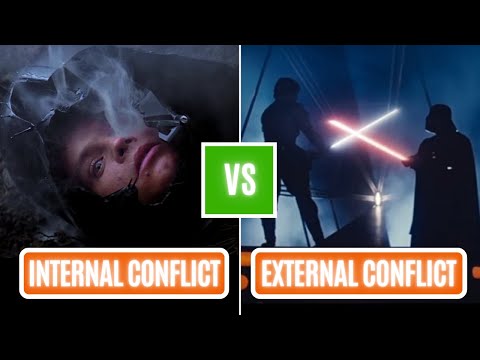
External and internal conflict work together, but they operate differently. Understanding their distinctions helps writers build layered narratives. Review the chart below for a side-by-side comparison between ‘what is an external and internal conflict?’
External Conflict | Internal Conflict |
|---|---|
Outside force | Psychological struggle |
Drives physical action | Drives emotional decision-making |
Visible obstacles | Invisible tension |
Often plot-focused | Often character-focused |
What is an internal conflict and an external conflict?
What is an external and internal conflict?
How internal & external can crossover
A story with staying power and narrative tension weaves together internal and external conflict, allowing them to influence one another in a beautiful pattern of cause and effect. A society conflict and a personal conflict may be one and the same, and this can really increase the dramatic tension.
Let’s look at Roofman, written and directed by Derek Cianfrance, to further our understanding of internal vs external conflict.
In Roofman, Channing Tatum plays Jeffrey Manchester, a man who robbed dozens of fast food restaurants, escaped prison, and hid in a toy store for six months. (And that’s just the spoiler-free version.) But beneath this sequence of unbelievable events lies something deeper: a man in emotional crisis.
The film could have stopped there, packed with heists and hiding spots, full of action. Audiences might’ve called it “fun!”
Instead, Cianfrance weaves external conflict with core truths about the human experience, shown through the character’s internal struggles.
We may not know what it’s like to run from the law and live in a toy store, but most people know the feeling of shame, of wanting to be better. To be good.

Channing Tatum Stars in Roofman
What is external conflict?
Internal and external conflict example from Roofman
Both internal and external conflict appear throughout Roofman. Take a look at how they both converge to create sympathy and propel the narrative forward.
External: Manchester is running from the law, lying to people who love him, hiding in plain sight.
Internal: He feels deep shame, longing to be a good father, but believes his past has made that impossible.
This is the epitome of Character vs. Destiny: Manchester wants to start over but can’t escape what he’s done. We know from the start that he’ll fall and we root for him anyway. We want to see where the character development goes from here.
When internal conflict (emotion) drives external action (plot), you get what people call a “character-driven” film and what audiences remember long after the credits roll.
In life, they say challenges are character building and the same goes for film. Without external conflict we get stories that lack tension, stakes, or anything to push our protagonist forward. The more the character struggles, the more real and relatable they become for the audience. When external conflict is through the roof (pun intended), and internal conflict is deeply human, the result is a story that works on multiple layers. It’s not just seen or read, it’s felt.
What is external conflict?
What are common mistakes when writing external conflict?
Strong external conflict adds momentum and meaning to a story. But when mishandled, it can flatten tension and weaken the entire plot. Avoiding these common pitfalls can make the difference between a gripping narrative and a forgettable one.
Conflict resolves too easily: If the protagonist overcomes obstacles without real struggle or sacrifice, the story feels unearned. Meaningful conflict should demand effort, risk, and consequence before resolution.
Stakes aren’t clear: When the audience doesn’t understand what could be lost, tension disappears. Clearly defined stakes give every confrontation weight and urgency.
Antagonist lacks depth: A one-dimensional villain weakens the conflict because their opposition feels arbitrary. Even antagonists should have motives, logic, or humanity that make the struggle believable.
Conflict doesn’t escalate: Repeating the same type of obstacle or type of conflict drains momentum. Each new challenge should intensify the difficulty or raise the cost of failure.
No link to internal struggle: External conflict becomes far more powerful when it pressures a character’s inner flaw, fear, or belief. Without that connection, the conflict may feel mechanical rather than transformative.
What is external conflict?
5 steps to write strong external conflict
Compelling external conflict is built through deliberate escalation, meaningful stakes, and active opposition. When done well, this type of conflict creates momentum that pulls the audience through every act of the story.
1. Raise stakes
Make it clear what the protagonist stands to lose, and increase that cost as the story progresses. Personal, relational, or life-altering consequences keep the audience invested.
2. Escalate obstacles
Each challenge should be more difficult than the last, forcing tougher decisions and greater sacrifice. Repetition weakens tension, but progression strengthens it.
3. Give antagonists agency
A strong antagonist doesn’t just react, they also act. When the opposing force has clear goals and takes proactive steps to win, the conflict feels dynamic and alive.
4. Tie conflict to theme
External struggles resonate more deeply when they reflect the story’s central idea. The opposition should test what the story is ultimately trying to say about power, identity, justice, love, or survival.
5. Ensure consequences
Every action should leave a mark. Wins should come at a cost, and failures should reshape the path forward, reinforcing that the conflict truly matters.
Frequently Asked Questions
Synonym FAQs
An external conflict in literature is a struggle between a character and an outside force such as another person, society, nature, technology, or the supernatural. An external conflict definition in literature drives the plot forward by creating obstacles the protagonist must overcome.
External conflict in a story refers to visible, outward challenges that stand in the way of a character’s goal. These conflicts create action, tension, and momentum within the narrative.
Internal conflict occurs within a character’s mind, involving emotions, doubts, or moral dilemmas. External conflict happens outside the character, involving tangible forces or opponents.
External conflict means a character is facing opposition from something beyond themselves. It typically involves physical, social, or environmental obstacles that must be confronted directly.
Internal conflicts are psychological struggles that take place within a character’s thoughts or feelings. External conflicts are outward struggles between a character and outside forces that shape the story’s events.
An example of external conflict is Katniss fighting to survive the deadly arena in The Hunger Games. She must battle other tributes and the oppressive Capitol, both of which stand outside of her personal thoughts and emotions.
The five primary types of external conflict are character vs. character, character vs. nature, character vs. society, character vs. technology, and character vs. supernatural. Each involves a protagonist facing an outside force that creates obstacles and drives the plot forward.
External conflict involves struggles between a character and outside forces, while internal conflict happens within a character’s mind or emotions. External conflict creates visible obstacles, whereas internal conflict shapes personal growth and decision-making.
While some literary fiction minimizes overt external conflict, most stories require at least some external obstacle. Without opposition, tension weakens and the plot lacks forward momentum.
External conflict creates tension, raises stakes, and propels the narrative toward a climax. It forces characters to act, make decisions, and change.
No. Man vs self is internal conflict because the struggle occurs within the character’s thoughts, emotions, or moral dilemmas rather than against an outside force.
Related Posts
Up Next
Energize Your Story With Conflict
For more on how blending internal and external conflict can elevate your storytelling, check out the next article.
Up Next: Applying Internal vs. External Conflict →