On the days where inspiration and new ideas are hard to find, brainstorming can be a creative’s best friend. However, not all brainstorming is created equal, and one method may be better than the several available when it comes to facilitating your next big breakthrough. So how do you choose? We’re breaking several of the best brainstorming techniques, along with when and how to use them.
We’ve included real-life examples of how professionals brainstorm so that no matter what creative quandary you find yourself in, you’ll know how to brainstorm your team or yourself out of it.
Brainstorming techniques list
First, let’s define brainstorming techniques
Brainstorming is most useful when you need many possible directions such as story beats, solutions, campaign concepts, scenes, names, or angles before choosing one to refine.
Before we go into all the different types of brainstorming techniques at your disposal, let’s refresh ourselves on what exactly brainstorming is.
Brainstorming Techniques DefinitionWhat are brainstorming techniques?Brainstorming is a method of ideation in which an individual or team generates, develops, and then evaluates several new ideas in order to address problems or explore opportunities. Brainstorming techniques allow you and your team to utilize structured ideation, which by using a clear, specific process for brainstorming, facilitates not only better ideas, but does so more reliably. Brainstorming techniques provide transparent and easy-to-follow approaches to engage in divergent thinking, where the priority is to generate as many ideas as possible, and convergent thinking, the process of selecting the best solution. They are several types of brainstorming techniques that can be useful for different creative or logistical situations. |
Popular brainstorming techniques include:
- Rapid ideation
- Mind mapping
- Brainwriting (silent brainstorming)
- SCAMPER
- Reverse brainstorming
Brain storming techniques
Why brainstorming techniques matter
Brainstorming techniques matter because they help you generate more ideas, faster, without getting stuck on the first “good” answer during a brainstorming session. Structure reduces self-editing and makes collaboration smoother, so teams can build momentum instead of debating too early.
The best techniques also protect against common traps like groupthink, quiet participants getting overlooked, or ideas getting lost after the meeting.
In short: good brainstorming methods turn inspiration into a repeatable process.
How to Brainstorm
4 core rules when brainstorming
No matter which of the brainstorm methods you choose, the process works best when you follow the core principles of the process. They are deferring judgment, encouraging wild ideas, building on others’ ideas, and aiming for quantity over quality.
These principles allow for a safe, productive environment and prevent good ideas from being ruled out too soon.
1. Defer judgment
When beginning a brainstorm, it’s essential to defer judgement, or hold back on criticizing your, or your teammates' ideas. Why? By not immediately shutting an idea down, you not only allow for a high volume of ideas to come forth, you also foster creativity and create a safe, encouraging environment that leads to better ideas.
2. Focus on quantity first
Focusing on quantity in your initial brainstorm isn’t just about ensuring you have a wide pool of ideas to choose from, it also helps to eradicate perfectionism. When you focus on generating as many ideas as possible rather than finding the “right one”, breakthroughs and hidden gems can emerge that may not have come to mind otherwise.
3. Build on others’ ideas
Ever hear of the term “yes, and…”, where you agree with someone’s idea and add your own idea/spin to it? That’s essentially building on others’ ideas and imperative to brainstorming, since the practice reduces ownership and ego throughout the process, encourages divergent thinking, and increases both engagement and inclusion.
4. Encourage wild ideas
While at first encouraging wild ideas may seem, well, wild, it’s actually quite necessary for a productive brainstorm. Encouraging wild ideas compels people to think outside of the box and can bring forth bolder, more specific breakthroughs than if participants were just trying to “play it safe” during the process.
Here’s a quick breakdown on how to brainstorm effectively:

Core Brainstorming Principles
Now it’s time to dive into all the different ways you can brainstorm for your next project.
Related Posts
Brainstorming techniques
How to brainstorm in 4 easy steps
Knowing different brainstorming techniques is helpful…but how do you actually run a productive session from start to finish?
Here’s a simple framework you can use for any creative project:
Define the problem clearly: Write down exactly what you’re solving. A vague prompt creates vague ideas. Be specific
Generate ideas without judgment: Use a technique like rapid ideation, brainwriting, or mind mapping to create as many options as possible within a set time limit.
Organize and group ideas: Cluster similar concepts together. Look for patterns. Combine duplicates. Highlight the most exciting options.
Refine and develop: Take the strongest ideas and expand them into something actionable — a scene outline, campaign concept, feature list, or execution plan.
The difference between a productive brainstorm and a chaotic one often comes down to documentation. If ideas aren’t captured clearly, they disappear.
That’s why many creative teams use tools like StudioBinder to support the brainstorming process.
Trusted by over 1M creatives
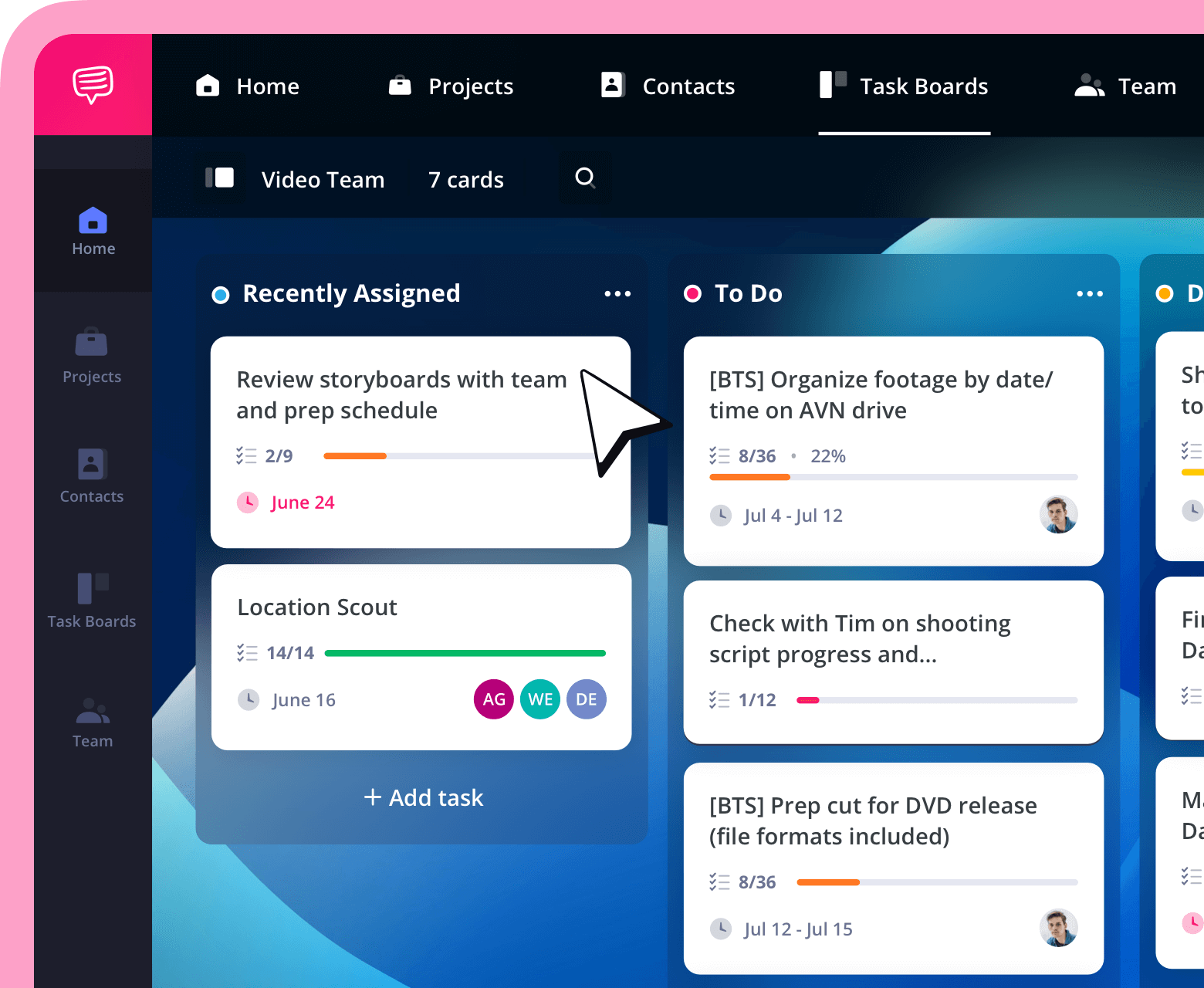
Task boards for production teams
Organize production tasks in boards, assign owners, and keep the team aligned.
Brainstorm techniques
20 brainstorming techniques list to try
The good news? There are several types of brainstorming methods for you to utilize when cracking your next big idea. But choosing the best brainstorming techniques to aid your creative process depends on whether or not you’re brainstorming on your own or in a group, as well as what outcome you’re working toward. We’ve selected the brainstorm methods that suit creatives best:
1. Rapid ideation
Rapid ideation may be one of the brainstorming methods you’re most familiar with. It involves setting a time limit to generate as many ideas as one can around a specific problem or concept. For instance, you set a timer for three minutes and brainstorm as many ways a character could escape a snake pit as possible.
Introducing a time constraint helps to eliminate one’s inner critic, since with brainstorming, quantity matters more than quality at first, and a tight turnaround can help concentrate creativity and defer judgement whether or not the ideas are “good” or not.
Rapid ideation can be practiced by yourself or as part of a team brainstorm. In a group setting, it may be helpful to start a brainstorming session with individual rapid ideation, then have each group member share in order to avoid one or two voices dominating the discussion.
Rapid ideation can be done in StudioBinder’s Docs. Set a timer and list ideas quickly without editing, then highlight or organize the strongest ones afterward.
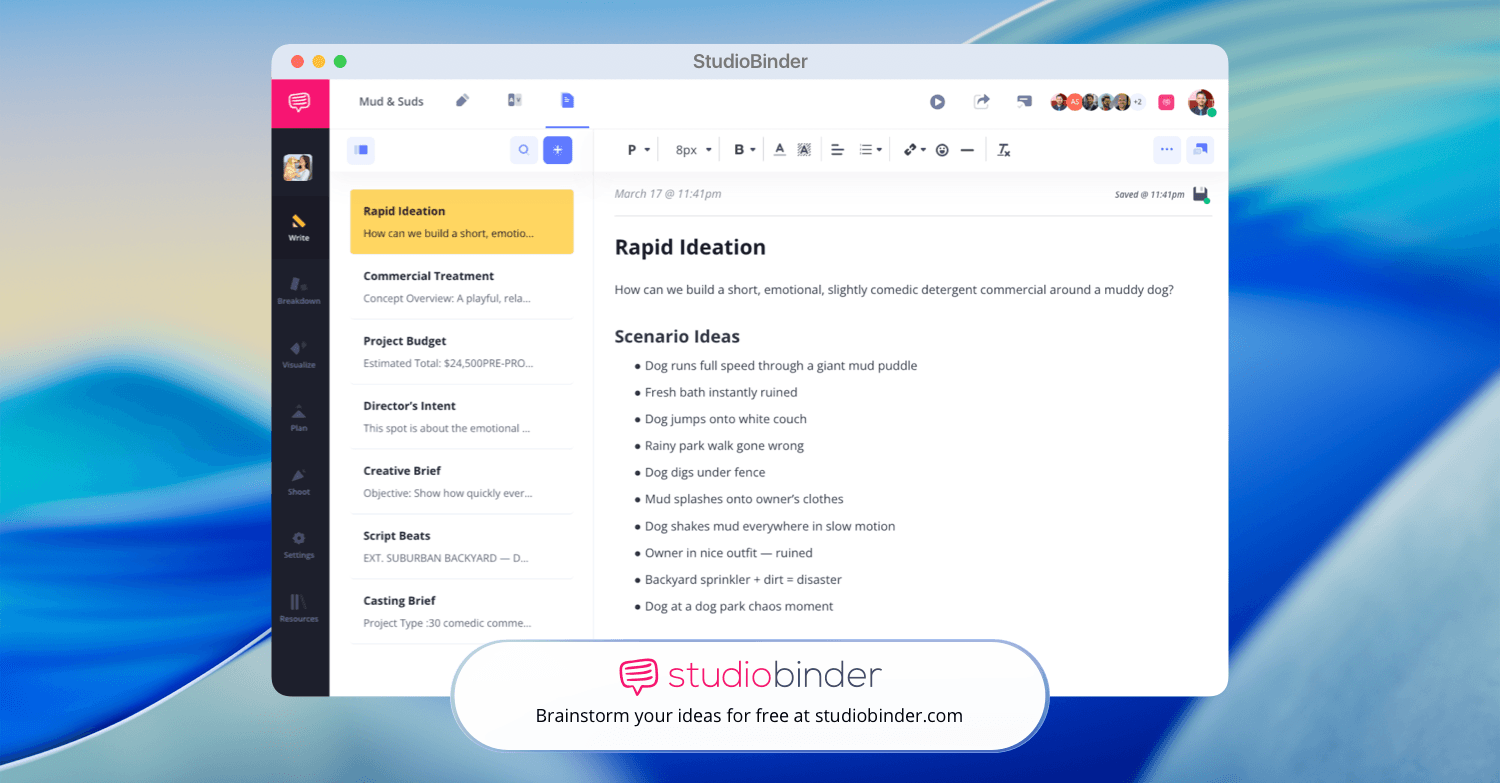
Rapid Ideation Brainstorming Technique in StudioBinder
2. Mind-mapping
Mind-mapping is one of the brainstorming techniques that can be practiced individually or in a group. To mind-map, start with a question or topic in the center of your page or board and then branch off from there with any related thoughts or ideas. Mind-mapping is a nonlinear way to organize one’s thoughts, and is particularly helpful when you’re brainstorming around a broader theme or problem in one’s work.
3. Gap-filling
Gap-filling is among the brainstorming techniques particularly helpful for writers when they hit a writer’s block. Sometimes called “gap analysis”, this brainstorming technique has one goal: identify their current state, or a story or character’s current state, then their end goal. Next ask the question “How do we get from here to there?”
To do so, you can use rapid ideation or mind maps to fill in the gap and come up with workable solutions. This is a great brainstorming method for when you’re scripting an outline, whether as a group or on your own, and need to ideate specific ways your characters get from plot point to plot point.
To write a script outline with the gap-filling brainstorming technique, visit StudioBinder’s AV scripting page.
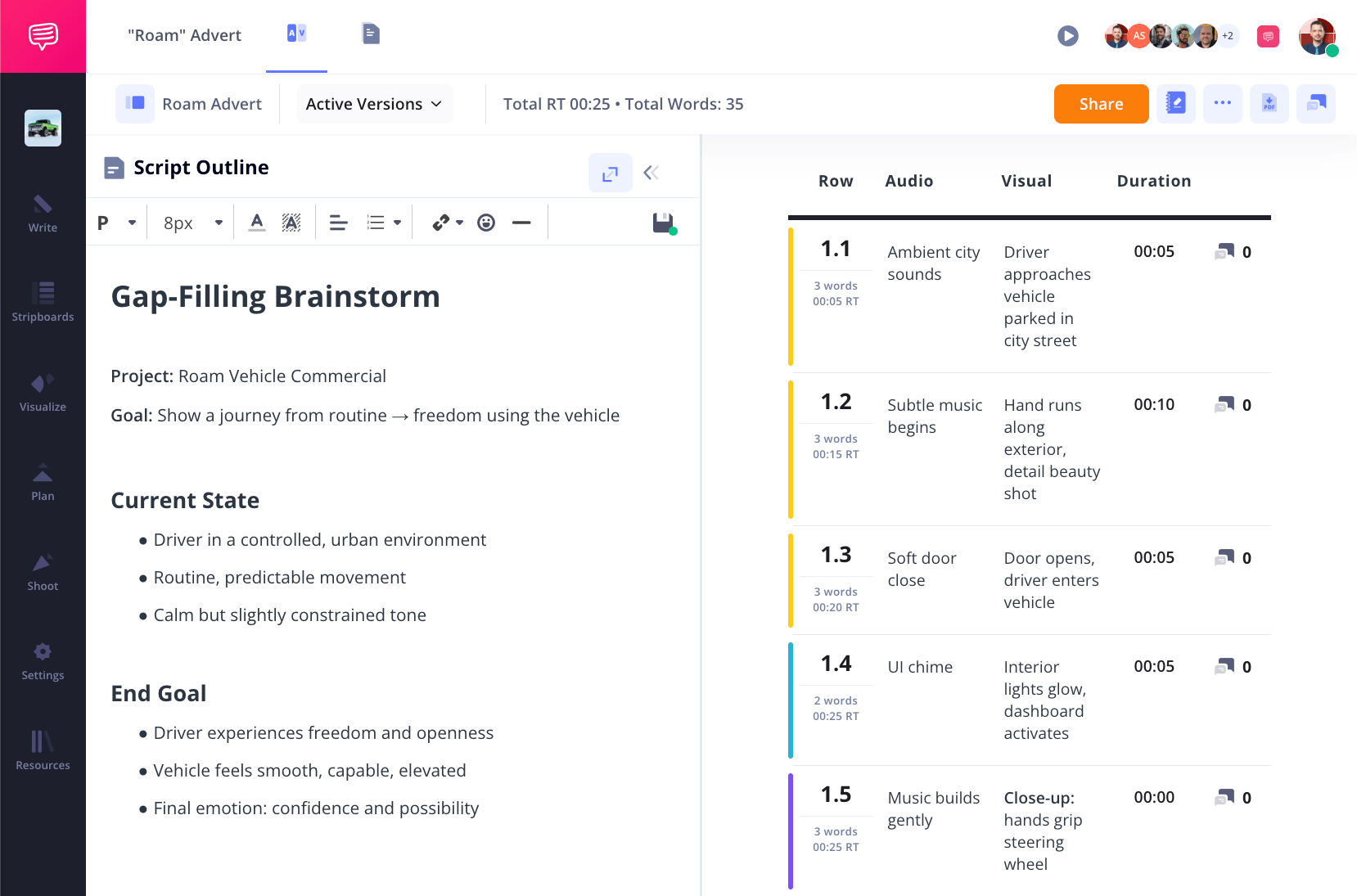
Gap-filling Brainstorming Technique in StudioBinder
Trusted by over 1M creatives
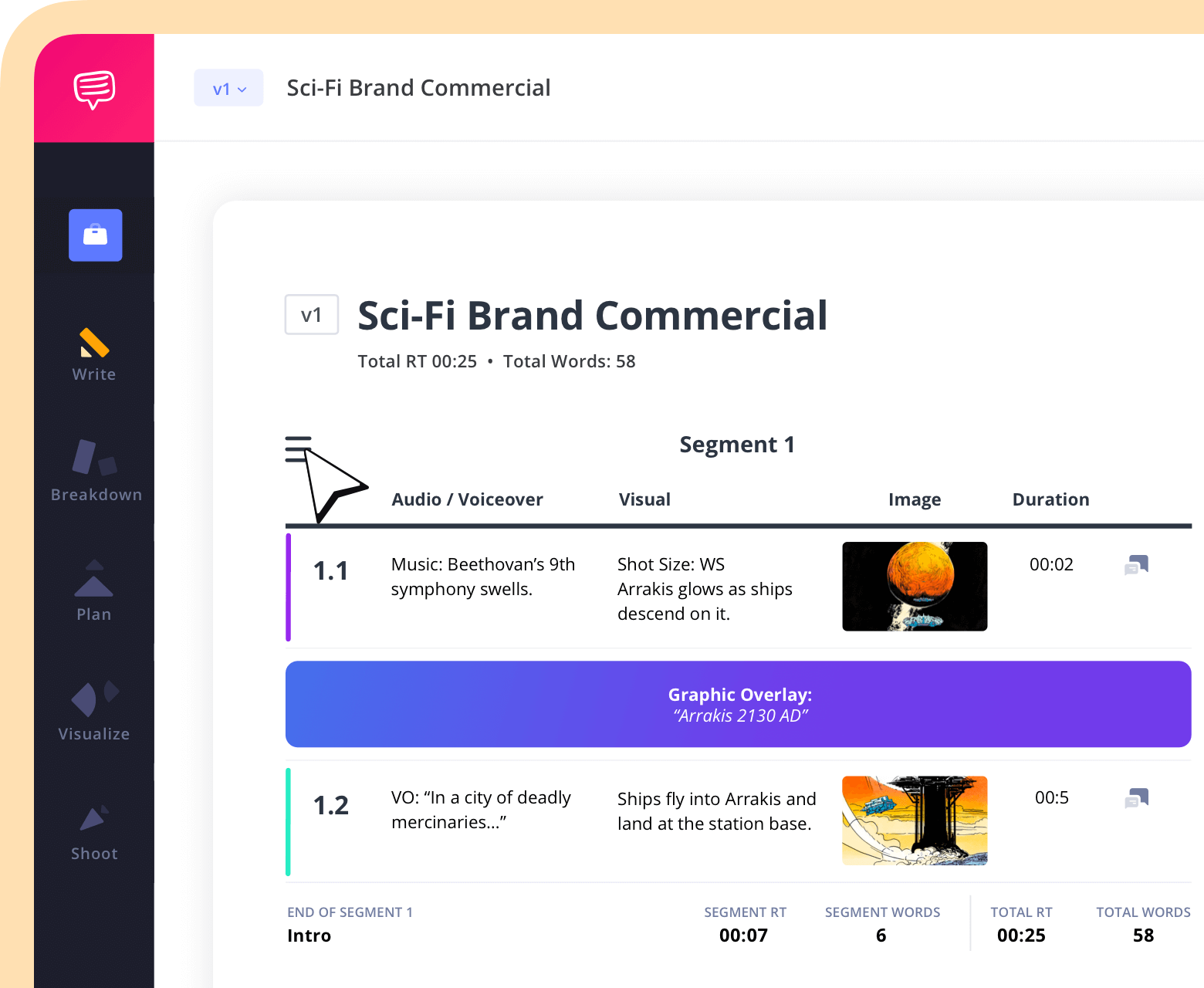
AV scripts with built-in timing
Write in two-column format, track runtime, and share with version control
4. Brainwriting / Slipwriting
When it comes to brainstorming techniques, brainwriting (or slipwriting) is one of the most effective facilitation techniques to make sure all voices are heard in a group. To do it, each person in the brainstorm writes three ideas relating to the topic on three pieces of paper. They then pass their papers to the left or right for their neighbors to build upon their ideas.
This method of idea-sharing and collaboration continues non-verbally until the papers have made it all the way around the table to every participant. Only then are the ideas discussed or reviewed by the brainstorm’s facilitator.
The non-verbal communication in this brainstorming method prevents one or two voices from dominating the conversation, and encourages introverted participants to contribute without putting them on the spot.
5. Five Why’s
Another method that falls into brainstorming techniques for writing, the 5 Why’s is exactly what it seems - it requires that an individual or team ask “why?” five times when addressing an issue or topic.
Five Why’s Method
This mode of brainstorming methods allows you to get to the root of an obstacle, and can also be incredibly useful for writers, actors, and/or directors when they’re diving into a character’s motivations.
Learn more about crafting compelling character motivations in our video below:

Brainstorm Techniques - 5 Why’s and Character
6. Reverse Brainstorming
It may seem counterintuitive but reverse brainstorming is a technique that can be a very effective way to push past obvious solutions and hone in on the heart of an issue – whether it’s in your script or with your crew.
Instead of figuring out ways to solve your problem or make something work better, in reverse brainstorming, you ask yourself or your team “how could we make this worse?” or “how could this fail?” working backwards allows for new, potentially overlooked pathways to solutions.
7. Starbursting
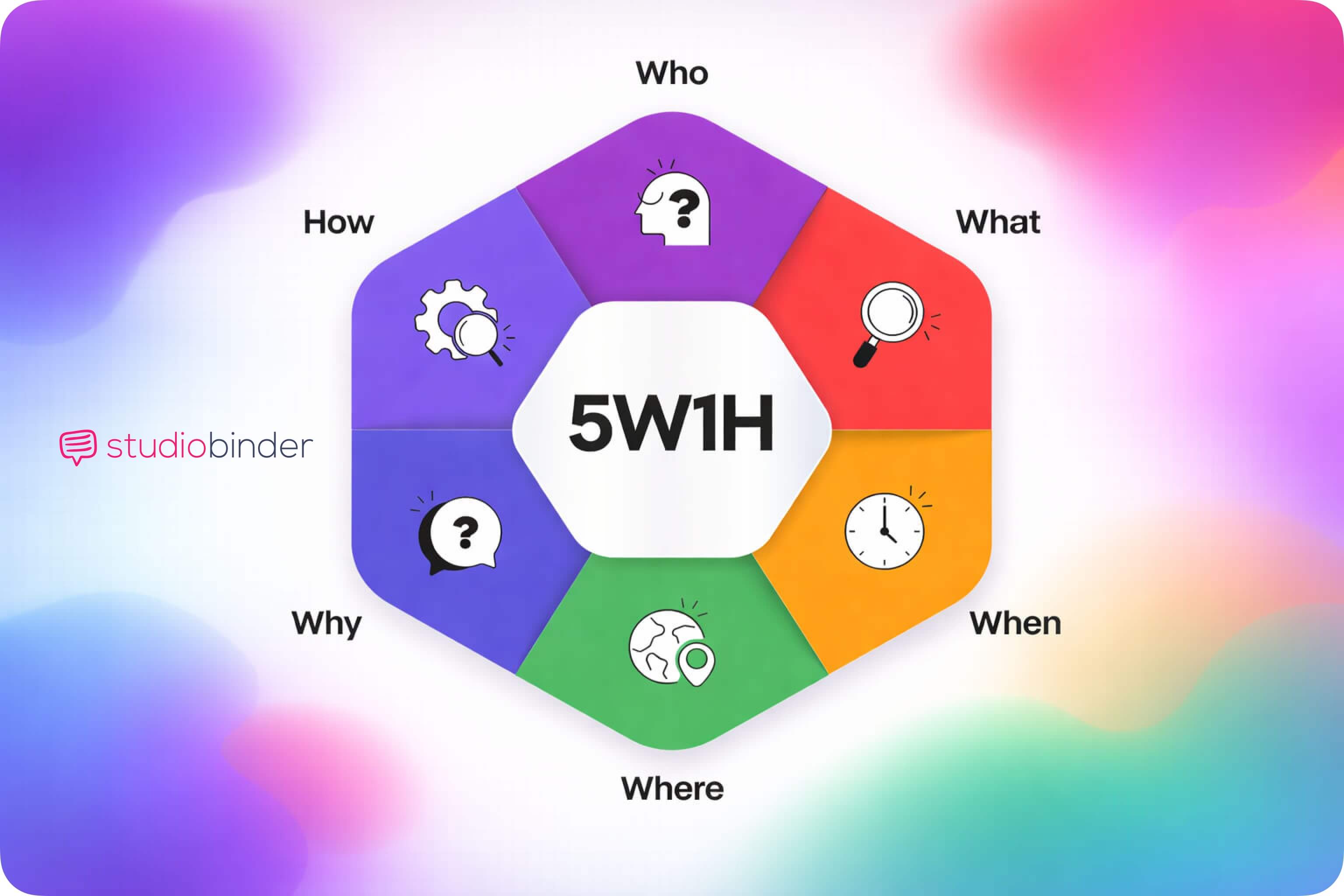
Like the 5 Whys, Starbursting also uses questions to drill to the core of a problem and facilitate new perspectives. The method uses a diagram of a six-pointed star. The topic or question at hand goes in the middle of the star, and then the questions who, what, when, where, why, and how all make up its points. From there, generate questions for each point pertaining to your topic. For instance, if you’re working on a new feature film or short film idea, you can fill the points with “Who is this movie for?”, “What are the themes of this script?”
Starbursting develops a deeper understanding of your topic at hand and is a handy way to organize the principles of your project visually.
8. Six Thinking Hats
Like the 5 Whys and Starbursting, the method centers around asking questions from varied perspectives to anticipate issues and discover solutions. The technique asks you to examine a problem with a different style of thinking – data, intuition or “gut feeling”, negative outcomes, positive thinking, creativity, and process control.
Check out a break down on each hat below:

Brainstorm Techniques - Six Thinking Hats
This technique works for problem solving and vetting ideas both in an individual and team environment.
9. Storyboarding
Storyboarding is a tried and tested tool of storytellers and filmmakers. It can also be a useful brainstorming tool, especially if you or your team tend to be visual thinkers. If you don’t prefer to write out your ideas and potential solutions to the task at hand, why not draw them?
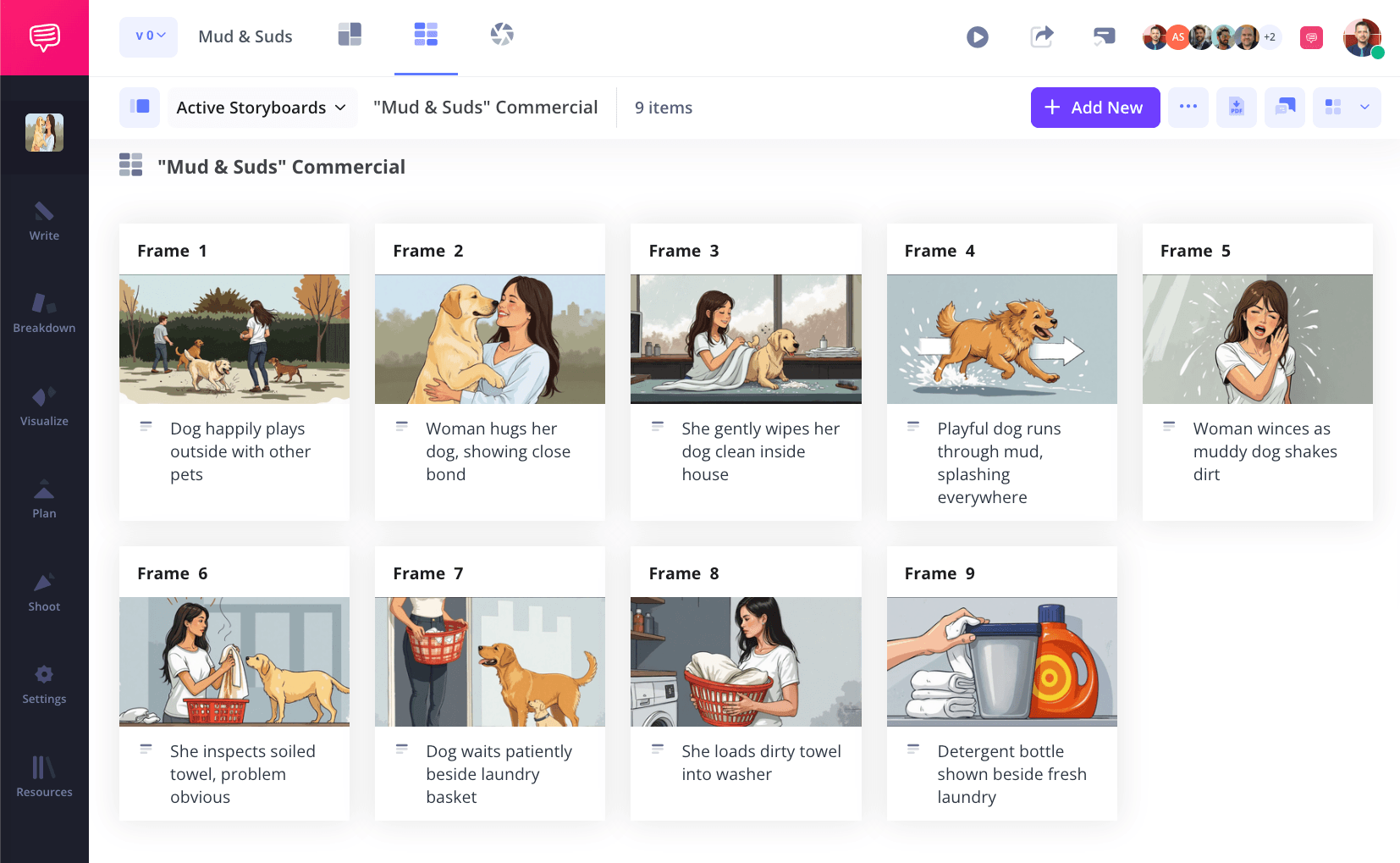
Brainstorm Techniques - Storyboarding
Even rough sketches can help to inspire your next big breakthrough. And if you’re curious on how to storyboard, never fear. We’ve created a step-by-step guide on how make your own below:

Brainstorm Techniques - Storyboarding
Related Posts
10. Figure-storming / Role-storming
Whether you do it alone or in a group, figure-storming ranks among the brainstorming methods as one of the best for character breakthroughs. Both figure and role-storming ask you to think like someone else, whether it be a famous figure from history or literature, or perhaps a character in the story you’re crafting.
To use this brainstorming technique, you ask how would someone else approach your problem or opportunity? If you’re figure-storming, maybe how would Abraham Lincoln approach this? Or if you’re role-storming perhaps it’s how would a supporting character in your script tackle a problem rather than your protagonist?
Learn more about how these brainstorming techniques are particularly good for unlocking creativity in the video below:

Brainstorm Techniques - Role and Figure-Storming
11. SCAMPER Method
SCAMPER is an acronym and a brainstorming technique that also encourages a deep multi-faceted exploration of the topic at hand, with each letter representing a different approach to improvement. It works particularly well for when you’re trying to improve an existing product or idea.
Substitute - What would happen if you swapped one aspect of the solution out with another?
Combine - What would happen if you combined two facets or ideas to create a solution?
Adapt - Consider how your idea could be used or adapted into a different context.
Modify - How could you modify an idea - either by magnifying or minifying it - to make a greater impact?
Put to another use - Consider how else you could leverage your idea.
Eliminate - What can be removed from the idea to simplify it?
Rearrange - How can you reorganize the idea to make it more effective?
12. Brainnetting
Brainnetting is one of the most straightforward team brainstorming techniques and great for remote teams. It involves designating an online document or board where team members can dump their ideas as well as comment and build upon others.
It’s best for the facilitator of this brainstorming method to establish parameters for brain-netting - such as deadlines to enter one’s ideas and specific questions/issues on the document to keep discussion from becoming overwhelming or venturing off-topic.
In StudioBinder’s Task Board, you can create designated columns based on your teammates or collaborators, and everyone can contribute their ideas. Column titles can be customized, so you can decide whether you want to create a title based on the collaborators name, or anything else.
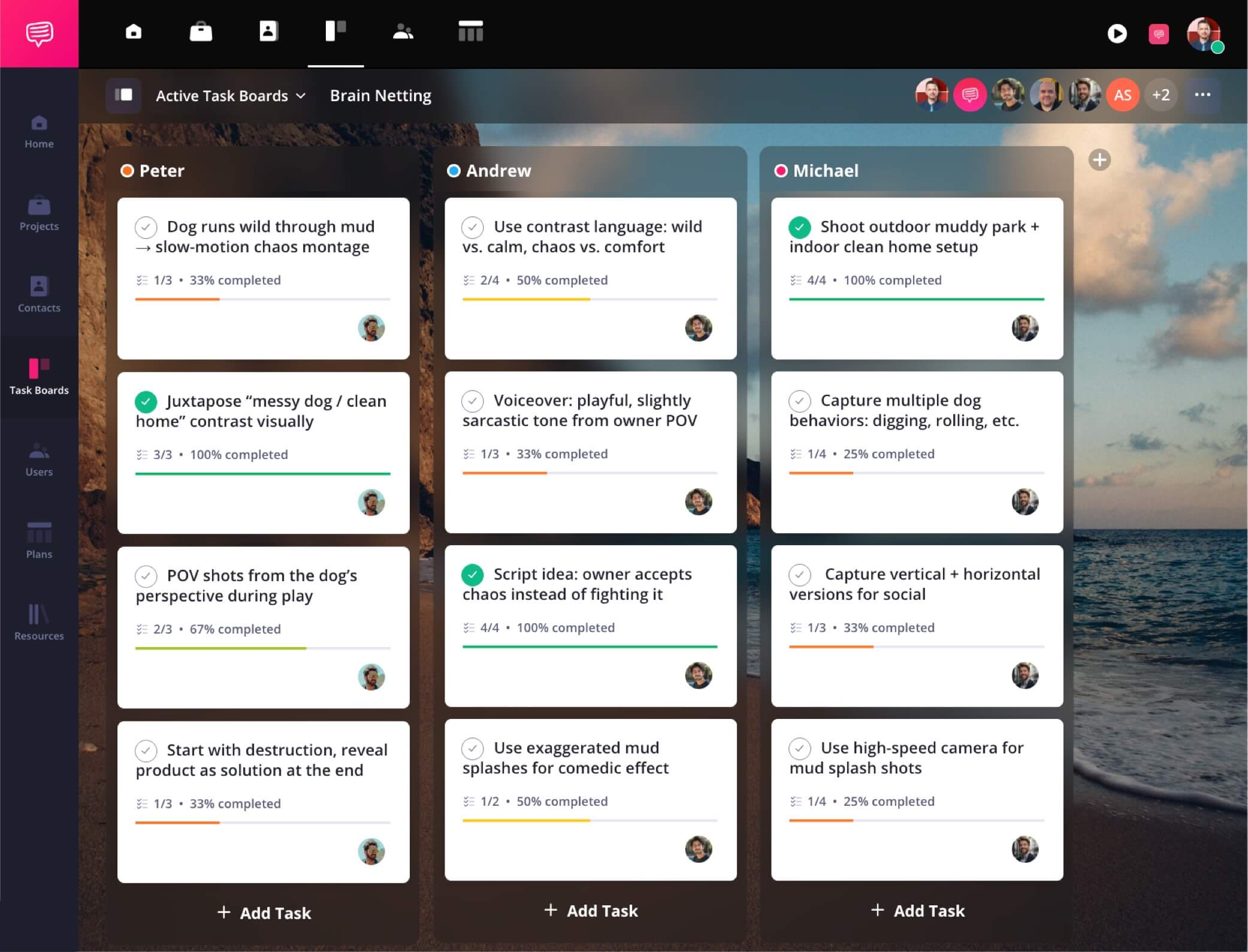
Brainstorm Techniques - Brainnetting
Related Posts
13. Step-Laddering
Step-laddering is another brainstorming technique that’s great for teams and prevents “groupthink”. In this type of brainstorm session, all but two participants leave the room or space.
First, the two remaining team members brainstorm on the question or opportunity at hand for a set amount of time. Then one more participant enters the room and joins the brainstorm for another interval. From there, participants enter one-by-one and build off the previous group member’s ideas.
After you generate ideas, the next step is to organize, combine duplicates, and choose what to develop. The techniques below help you turn a messy idea dump into a shortlist you can act on.
In StudioBinder Docs, you can replicate the step ladder approach by structuring a shared document in phases. Have two contributors draft their ideas in isolated sections first, then grant access to one additional collaborator at a time so each person reacts and expands on what’s already there.
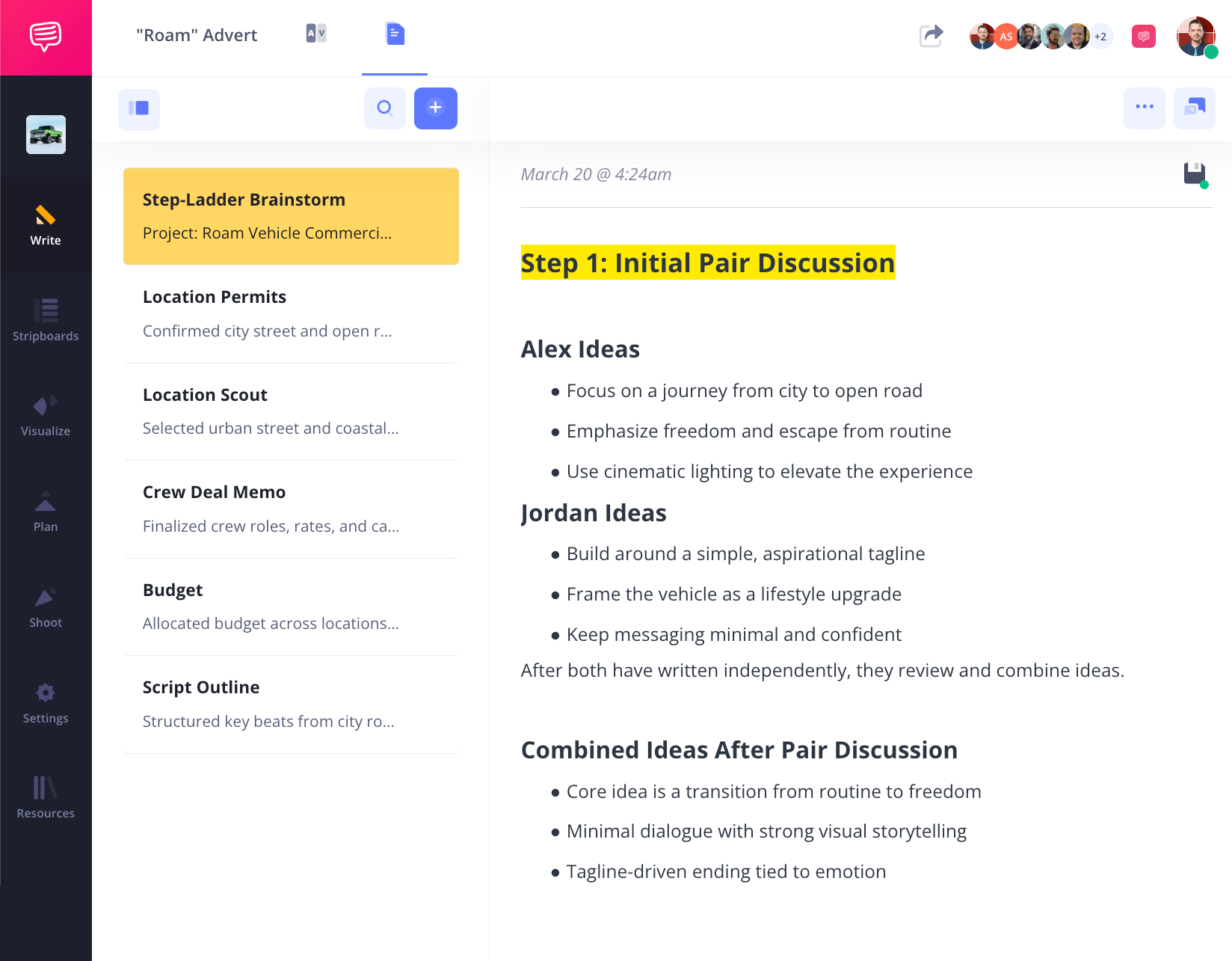
Brainstorm Techniques - Step-Laddering
This keeps early ideas from being influenced too quickly and helps prevent groupthink while still encouraging collaboration.
14. Crazy 8s
Although it sounds like a card game, Crazy 8s is one of the creative brainstorming techniques that really help you to defer judgement and focus on a quantity of ideas in your process. Fold a sheet of paper into eight sections and set a timer for eight minutes, aiming to generate one idea per section, such as titles of a project or product in one section, or poster ideas in the other. The speed prevents overthinking and judging oneself, and it’s a sketch-based brainstorming technique that’s popular in design and product teams. You can use this brainstorming method for visual concepts or feature ideas too. Afterward, circle your top one or two ideas and combine elements into stronger versions.
15. Affinity Mapping
Affinity mapping is a brainstorming methodology that can organize a messy idea dump into clear themes. While brainstorming on a topic, write each idea on a sticky note or digital card. Then, once you’re finished, take a step back and group similar ideas. As the clusters form, label each group with a theme such as character conflict, visual style, or marketing hook.
This form of idea generation makes it easier to spot patterns, eliminate duplicates, build a shortlist worth developing, and reframe your creative thinking.
In StudioBinder Task Boards, we can use the rapid ideation method couples with affinity mapping to ideate with structure.
Simply create a new Task Board, add your ideas, and move the cards as you’d like.
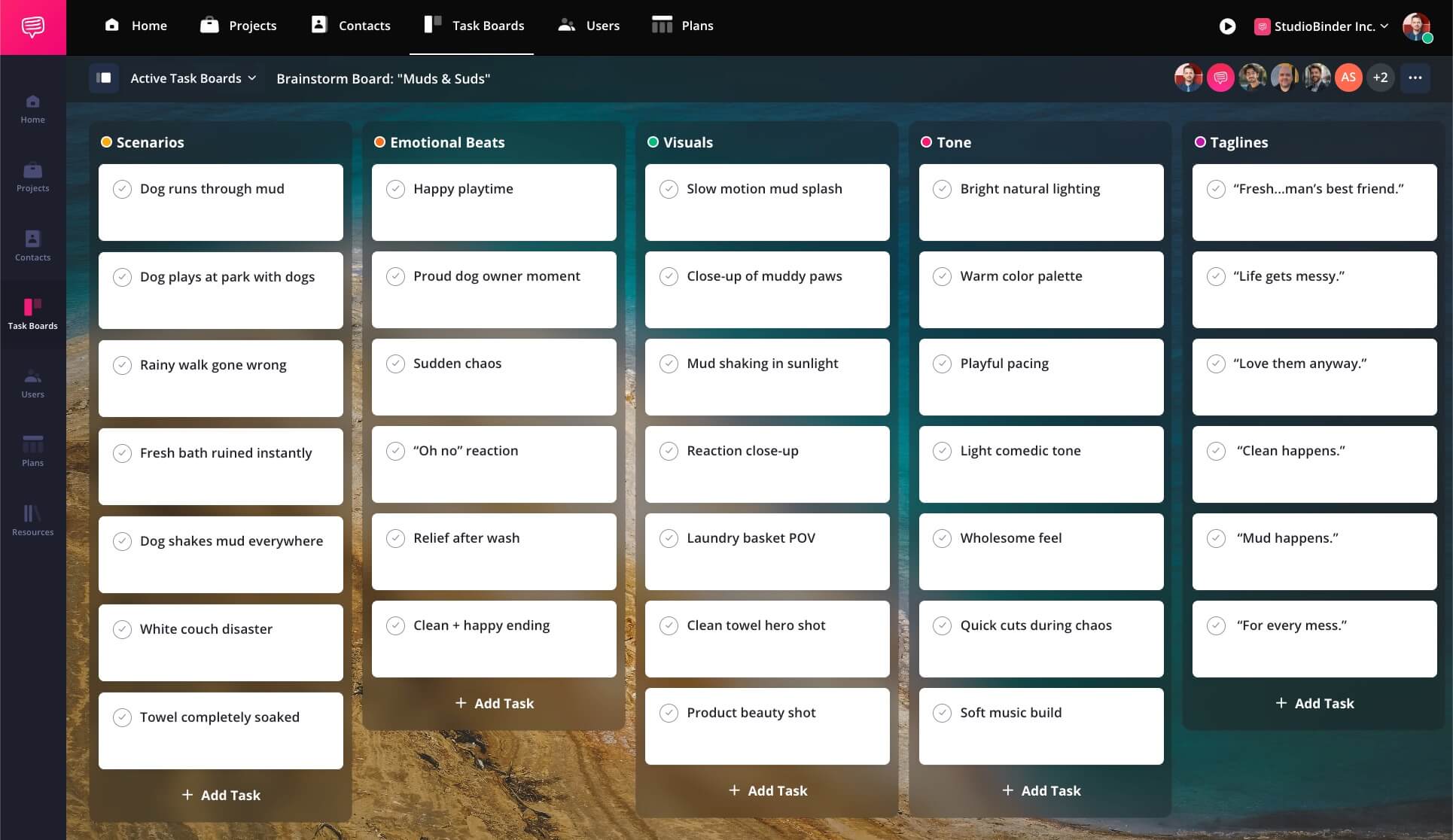
Brainstorm Techniques - Affinity Mapping
As filmmaker David Lynch said, “They’re like fish. If you get an idea that’s thrilling to you, put your attention on it and these other fish will swim into it. It’s like a bait. They’ll hook on to it and you’ll get more ideas. And you just pull them in.”
Affinity mapping can provide the bait to pull in more ideas.
16. Nominal Group Technique
The nominal group technique is a structured way to generate ideas, improve your innovation process, and vote on the strongest ones without loud voices steering the outcome. Similar to slip or brainwriting, this approach utilizes collaborative thinking by having everyone on a team brainstorm individually first. Then ideas are shared in a round robin format and clarified briefly. Next, participants privately rank or vote on the top options, and the highest scoring ideas move forward. It is ideal when you need alignment quickly and want decisions that aren’t influenced by the loudest or most senior voice in the room.
17. Lightning Decision Jam
Lightning Decision Jam, often shortened to LDJ, is a quick method for turning problems into action items that leverages both rapid ideation and group creativity. The group lists challenges, votes on the most important ones, then rewrites them into “How might we” questions to open up solutions. Next, the group individually comes up with solutions, then reconvenes to vote again on the best idea and assign action items. LDJs are one of the group brainstorming techniques that work best when a brainstorming session keeps circling the same issues and you need a clear next step.
18. SWOT Analysis
SWOT stands for strengths, weaknesses, opportunities, and threats, and it is a simple way to pressure test an idea before you commit. Place your concept, project, or campaign in the center of your physical or digital page, then draw four quadrants for each category. From there, fill out each quadrant with honest input from the team. For creatives, SWOT is an ideation framework that is especially useful for evaluating whether an idea has a unique hook, where it is vulnerable, and what external trends you can use to your advantage. Among the greater list of brainstorming strategies, it’s best to use SWOT analysis after an exercise like rapid ideation to choose the most viable direction.
In StudioBinder’s Task Board, you can map your SWOT analysis using the task board by creating four columns for Strengths, Weaknesses, Opportunities, and Threats.
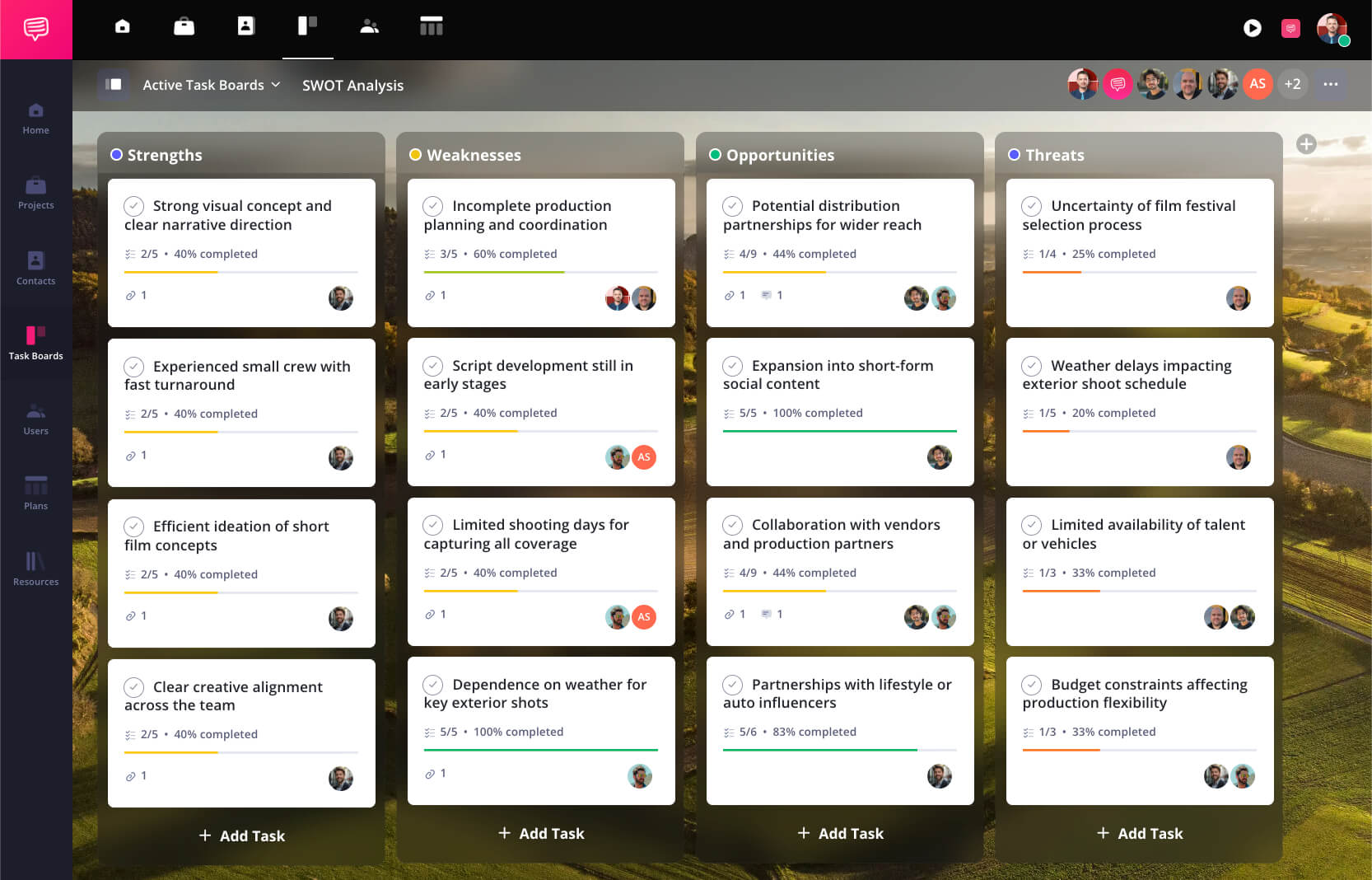
Brainstorm Techniques - SWOT Analysis
Team members can add cards under each category, attach references, and comment directly on ideas. Once patterns emerge, you can convert the strongest opportunities into actionable tasks.
19. Worst Possible Idea
Steven Spielberg once said, “‘All good ideas start out as bad ideas, that’s why it takes so long.” Worst Possible Idea embraces that philosophy for brainstorming ideas and solutions that lowers the fear of suggesting something bad, encourages divergent thinking, and can reveal surprisingly useful insights.
Set a timer and generate the worst, most cliché, or most disastrous ideas for your problem. Then flip each one into its opposite or extract a usable lesson, such as turning “too confusing” into “simplify the premise.”
Unlike other methods for brainstorming, Worst Possible Idea invites you and your group to embrace the challenges you’re facing, and is particularly effective for breaking creative blocks and resetting the group’s energy.
20. AI-Assisted Brainstorming
AI-assisted brainstorming uses tools like ChatGPT or Claude to generate variations, explore angles, and move past first draft thinking. It works best when you give the AI clear constraints such as genre, tone, audience, budget, or character goals so the ideas stay usable.
You can ask for multiple variations, combinations of ideas, or ranked suggestions to speed up iteration. Even though AI is becoming more sophisticated, nothing trumps your own creativity and brainpower. Treat AI output as raw material to refine rather than final answers, as mistakes and inaccuracies are still common.
Trusted by over 1M creatives
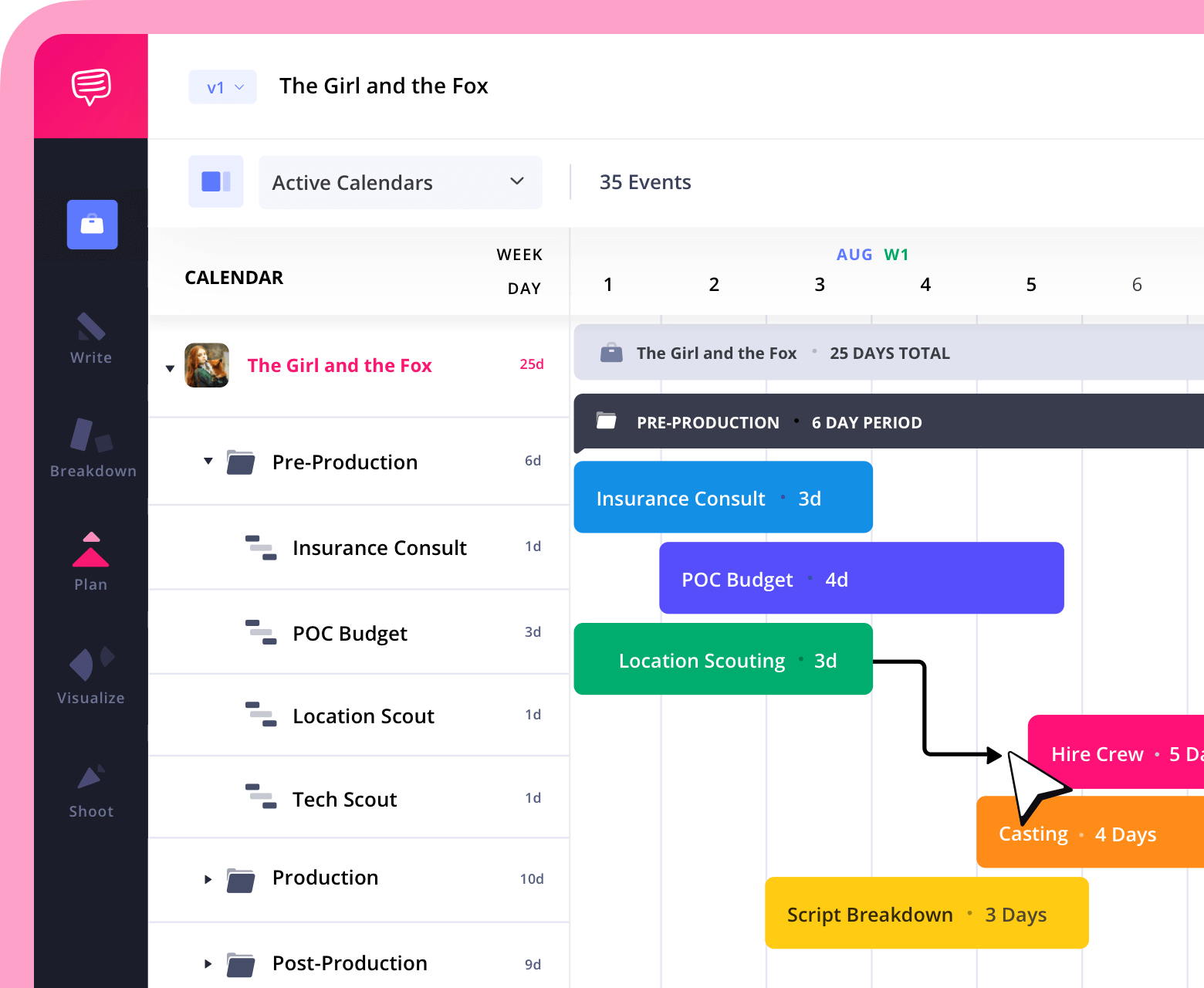
Production timelines, visualized
Plan and share production milestones, tasks, and files to stay ahead of schedule.
Brainstorming ideas
How to Brainstorm in StudioBinder
Brainstorming works best when ideas don’t just live on a whiteboard, they evolve and can be used in various formats. Here’s a simple workflow inside StudioBinder, using a mock video commercial example.
1. Add ideas to your board
Start by creating a Task Board and building simple columns that reflect how creatives think.
For our mock detergent commercial, we used:
- Scenarios (Dog runs through mud, rainy walk gone wrong)
- Emotional Beats (Happy playtime, sudden chaos, relief after wash)
- Visuals (Slow motion mud splash, close-up muddy paws)
- Tone (Playful pacing, warm color palette)
- Taglines (“Life gets messy.” “Freshness… man’s best friend.”)
Each idea becomes its own card. During rapid ideation, the goal is quantity. The idea stage of brainstorming is about adding quick thoughts, not overthinking.
As patterns emerge, drag the strongest combinations into a Selected Direction column. That’s where brainstorming shifts from exploration to decision-making. This mirrors the core principles of effective brainstorming: generate freely, then refine intentionally.
2. Flesh out your brainstormed idea
Once you’ve selected a direction, move into the Docs page to expand it. For this project, we turned this idea into a fleshed out treatment.
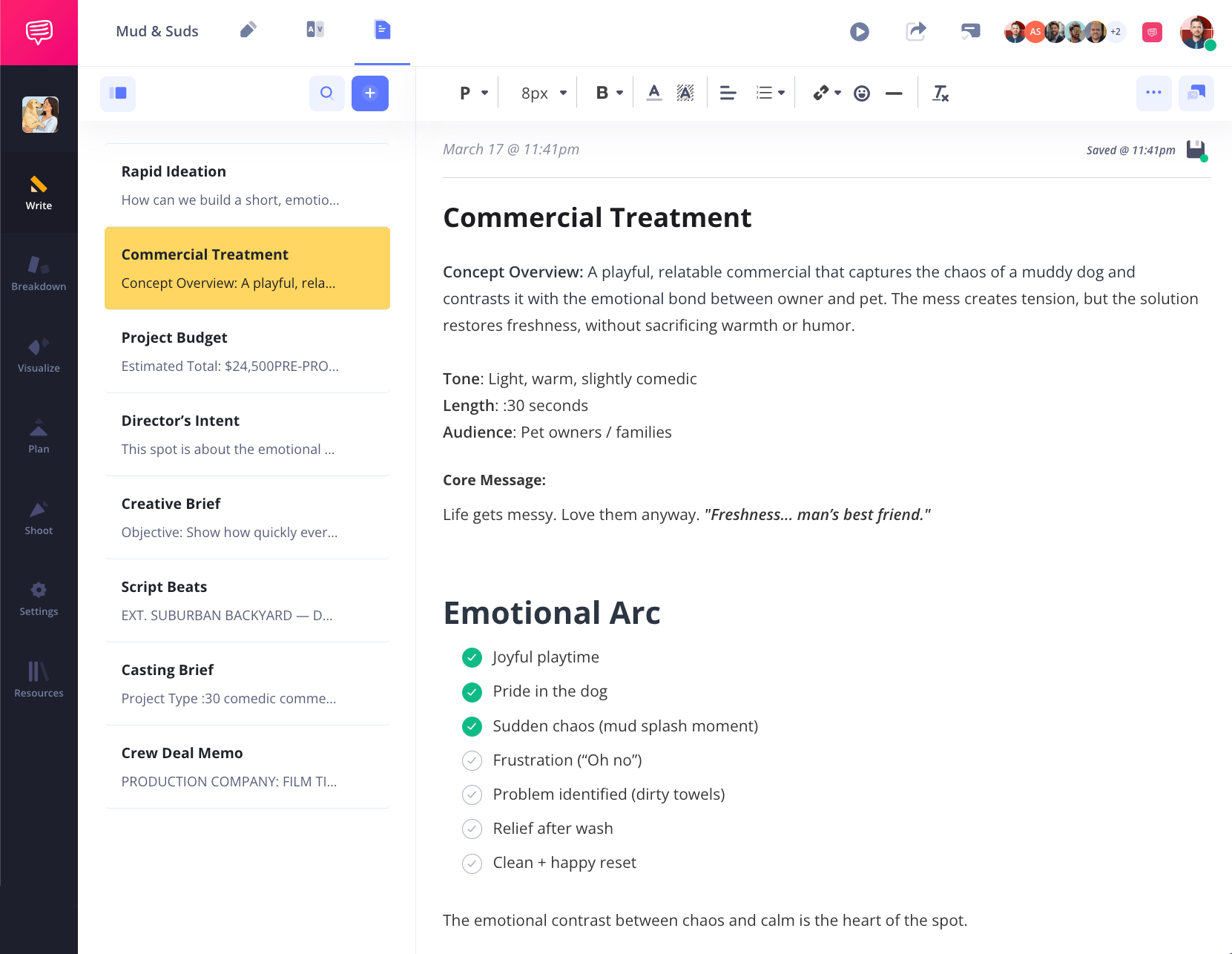
Brainstorm Techniques - Commercial Treatment Example
Inside Docs, you can:
- Write a structured concept overview
- Outline the emotional arc
- Build a beat-by-beat narrative structure
- Add checklists for key moments
- Insert reference images
- Refine tagline options
This is where messy ideas become a clear creative plan. Brainstorming is divergent thinking. Docs is where you begin converging.
3. Visualize with storyboards
With the treatment defined, the next step is visual planning.
Using StudioBinder’s Storyboard tool, we translated the beat outline into frames:
- Dog playing happily outside
- Slow motion mud splash
- Owner’s “Oh no” reaction
- Soiled towel reveal
- Clean reset and product beauty shot
Storyboards allow you to test pacing, shot composition, and emotional rhythm before production begins.
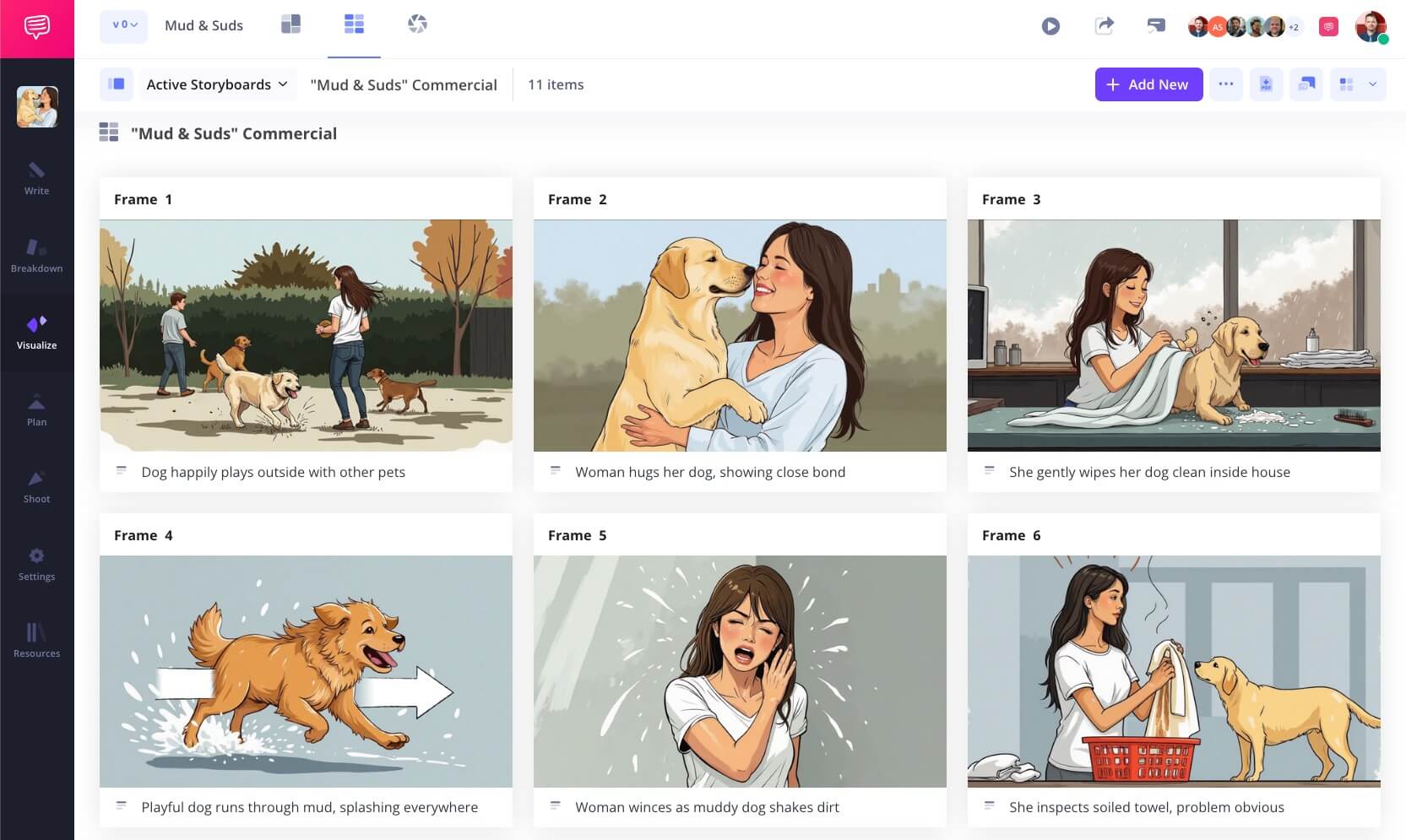
Brainstorm Techniques - Storyboard Example
While storyboards are often used after a concept is locked, many creators also use them earlier in the brainstorming phase to explore tone and visual ideas. Rough boards can spark new directions just as easily as refine existing ones.
4. Align with your AV script
Finally, we drafted the AV script.
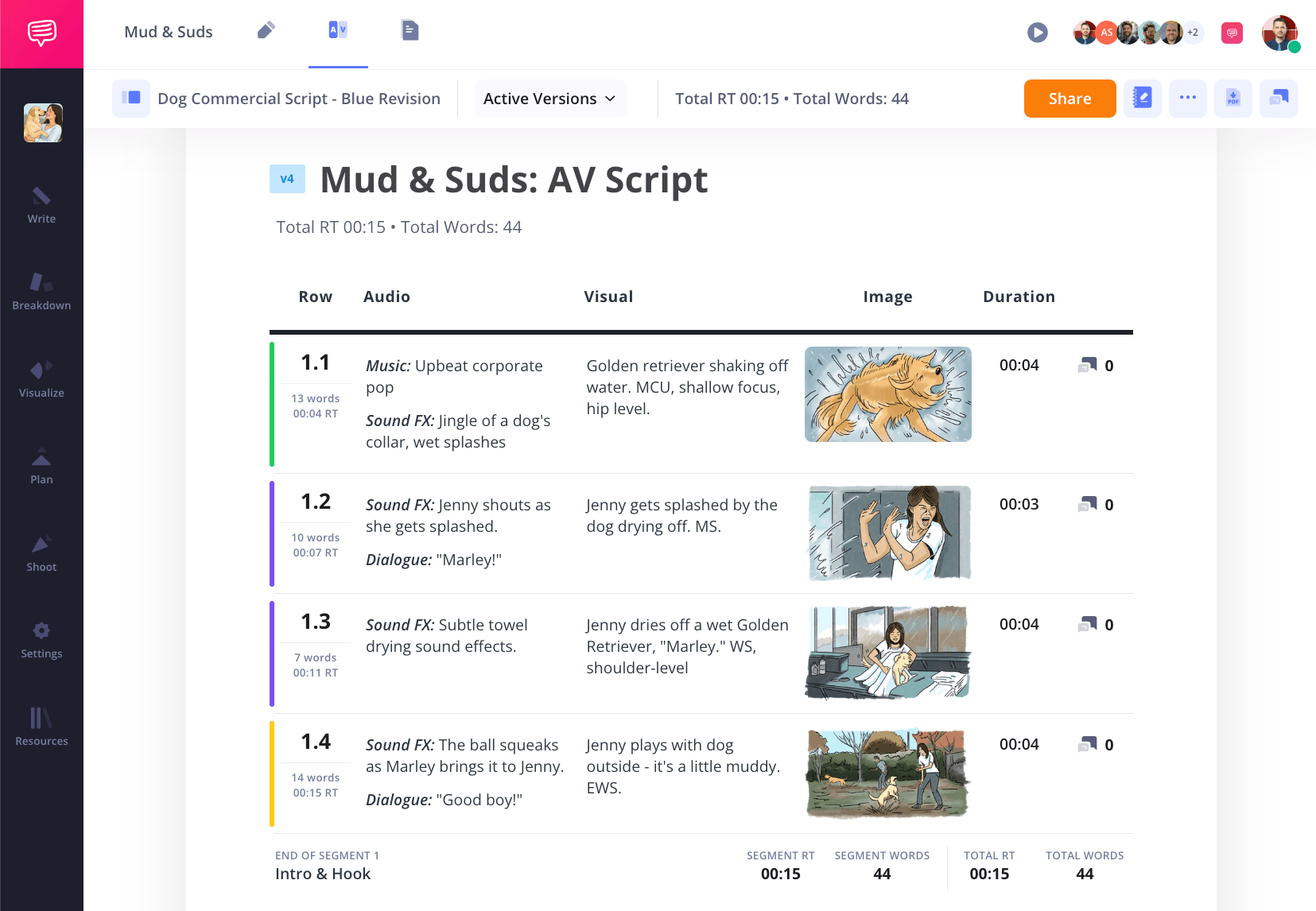
Brainstorm Techniques - AV Script Example
This step aligns:
- Music
- Sound effects
- Dialogue
- Voiceover
- Shot timing
The AV script ensures that your brainstormed concept translates clearly to screen. It bridges creative development and production without losing clarity. At this stage, what started as a handful of messy idea cards has become a fully structured commercial ready for execution.
Selecting the right brainstorming method for you
How to choose the right brainstorming technique
The best brainstorming technique largely depends on your goal. Are you generating as many ideas as possible, solving a specific problem, improving an existing concept, or choosing between options?
There’s also practical limitations to consider – are you working individually? If not, how big is your team? Are you working remotely or in-person? How much time do you have to devote to brainstorming. All of these factors play a role in deciding which workshop activities and creative exercises you can feasibly employ in your next brainstorm. To narrow down your options, use the matrix below to match your situation with the most effective method.
Brainstorming Technique Selection Matrix
If you're unsure which method to use, start by identifying the goal of your brainstorm, who’s participating, time constraints, and whether you're working remotely. Then use the chart below to match your situation with the most effective technique.
Situation | Technique | Why It Works | Team Size | Time Needed |
|---|---|---|---|---|
Generate lots of raw ideas quickly | Rapid Ideation, Crazy 8s | Time pressure reduces overthinking | 1–10 | 5–15 min |
Solve a specific problem | 5 Whys, Reverse Brainstorming | Gets to root cause or uncovers blind spots | 1–8 | 15–30 min |
Improve an existing idea/product | SCAMPER | Forces structured creative expansion | 1–10 | 20–40 min |
Explore a broad concept or theme | Mind Mapping | Nonlinear idea expansion | 1–12 | 15–45 min |
Avoid groupthink | Brainwriting, Step-Laddering | Prevents dominant voices | 3–10 | 20–40 min |
Analyze strategy or direction | SWOT Analysis, Six Thinking Hats | Structured evaluation | 3–12 | 30–60 min |
Understand audience or story depth | Starbursting, 5 Whys | Question-driven exploration | 1–8 | 20–40 min |
Unlock creative perspective | Figure/Role-Storming | Forces viewpoint shift | 1–6 | 15–30 min |
Visual thinkers / filmmakers | Storyboarding | Makes abstract ideas tangible | 1–8 | 30–60 min |
Remote team collaboration | Brainnetting, Digital Mind Mapping | Async participation | 3–20 | Flexible |
Brainstorming techniques for writing
Common brainstorming mistakes (and how to avoid them)
We’ve thoroughly explored in this post that there are several ways to brainstorm in order to get meaningful and actionable results. However, there are mistakes one can easily make that compromise a brainstorm, especially in a group setting. Here’s a quick list of things to avoid for your next brainstorming session:
Groupthink
Dominant personalities
Lack of structure
No follow-up
Over-criticism
Adhering to the four core principles of brainstorming – deferring judgment, building on others’ ideas, initially prioritizing quantity over quality, and encouraging wild ideas greatly helps to prevent making any mistakes.
Related Posts
Brainstorming techniques list
Best tools to assist brainstorming techniques
There are just as many tools as there are brainstorming techniques out there for you to leverage and incorporate into your process. Whether you’re brainstorming on your own or in a team, check out the tools below that are sure to level up your next brainstorming session:
Digital whiteboards
Collaboration software
Mind mapping tools
Printable worksheets
It’s important to get all the ideas down concretely so you and your team can clearly identify and execute next steps.
Frequently Asked Questions
Brainstorming Techniques FAQs
For groups, brainwriting and step laddering are two of the most reliable options because they prevent dominant voices from steering the session and provide a wealth of ideas for the group to choose and expand upon. Brainwriting gives everyone equal time to contribute, while step laddering introduces ideas gradually to reduce groupthink. If you also need to make a decision, pair either method with the nominal group technique for structured voting. SWOT analysis can also help groups realign their brainstorm around a common goal.
Start with silent, individual idea generation techniques such as rapid ideation, brainwriting, or a quick solo mind map before anyone speaks. It’s also helpful to designate a facilitator within the brainstorming session, as well as to set time limits, and collect ideas in writing so early opinions do not anchor the group. Techniques like step laddering and anonymous voting also help keep ideas independent and prevent one voice from dominating the session.
What are brainstorming techniques for introverts?
Introverts often thrive using brainstorming methods that reduce on the spot speaking, such as brainwriting, brainnetting, and solo mind mapping. These formats give people time to think and contribute without being interrupted. Crazy 8s and storyboarding also encourage creativity and can be completed individually. After ideas are collected, the group can discuss them with less pressure.
There are several different brainstorm techniques you can use for your work, such as mind-mapping, SCAMPER, starbursting, rapid ideation, and brainwriting. Yet, in all of these different techniques, the priority is one coming up with as many ideas as possible during a set time limit, and to not judge or dismiss any ideas at first. When brainstorming with others, you should seek to draw from diverse perspectives, build on others’ ideals, and allow everyone to weigh in.
Most brainstorming sessions work best in short bursts of 10 to 20 minutes for idea generation, followed by another 10 to 20 minutes to organize and select what to develop. Longer sessions can lead to fatigue and repetitive ideas without structure. However, there’s no fixed length for how long a brainstorming session should last. It all depends on one’s goal and how many participants are involved. If more time is needed, split the process into separate rounds with a short break in between.
A simple four step approach is to defer judgment, encourage wild ideas, build on others’ ideas, and generate quantity first. After you have many options, shift into refinement mode by grouping duplicates, prioritizing, and developing the strongest ideas. This keeps creativity flowing while still producing usable results.
UP NEXT
How to Brainstorm an Idea
Which brainstorming technique will work best for your project all depends on what you’re working on, and if you’re going it alone in a group. Brainstorming isn’t a one-size-fits-all process, and you may need to experiment with a few methods or combine techniques to find an approach that works for you. Ideas and inspiration can be fickle, but brainstorming is one of the best tools we have for harnessing them.
And now that you understand brainstorming, how to do it effectively, and all the different techniques at your disposal, it’s time to put it into action. Check out our step-by-step guide on how to brainstorm in StudioBinder.
Up Next: How to Brainstorm an Idea →

Project management for video creatives. Tasks, file sharing, calendars and more.
Manage video production timelines, tasks, storyboards, shot lists, breakdowns, call sheets. Made for video creatives, new media and film.