We’ve all faced the blank page or an unexpected problem that stops progress in its tracks. Whether you’re developing a story, solving an on-set issue, or launching a new product, brainstorming is one of the most effective tools for generating fresh ideas and practical solutions. But not all brainstorming sessions produce results.
In this guide, we’ll define brainstorming clearly, break down its core principles, and show you how to run sessions that actually lead to breakthroughs.
Define brainstorming
First, let’s define brainstorming
While we all may have a general idea of what the process is, what does brainstorming mean, really? Nailing down a precise definition is essential to improving how we ideate.
Brainstorming DefinitionWhat is brainstorming?Brainstorming is a structured method of idea generation in which individuals or teams rapidly produce and develop ideas to solve problems or explore opportunities. Evaluation comes later, allowing creativity to flow without early judgment. Brainstorming typically combines individual thinking with group collaboration to uncover fresh perspectives and push past obvious, or tired solutions. |
Brainstorming examples include:
- Mind-mapping and affinity mapping
- Rapid ideation
- Reverse brainstorming
- The SCAMPER method
- Starbursting
- Brainwriting
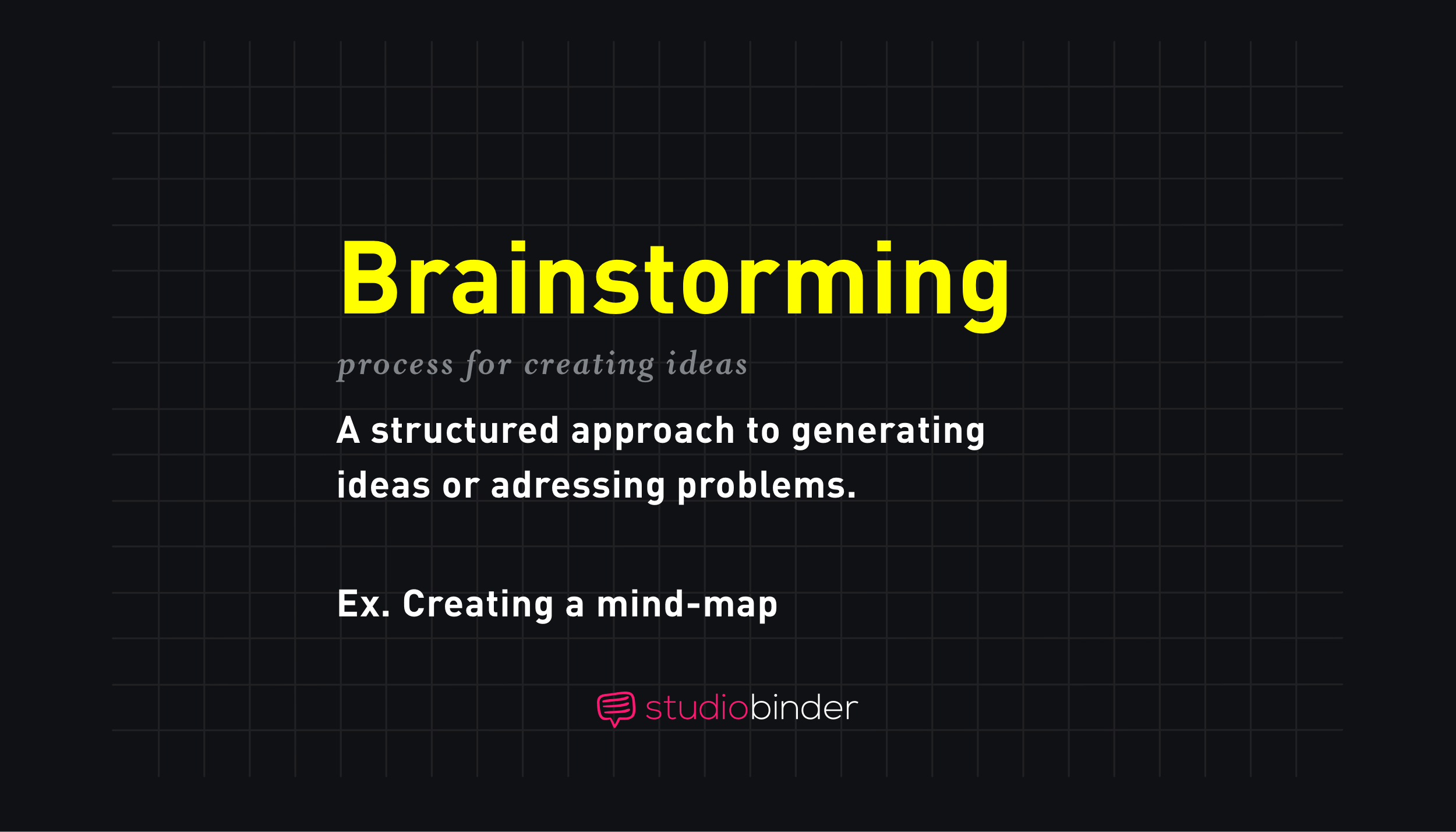
Brainstorming Definition and Example • Brainstorming Technique
The purpose behind brainstorming
What is the purpose of brainstorming?
The beauty of brainstorming is that it helps you generate a wide range of ideas quickly, pushing past any blocks and discovering new solutions and approaches. Since the concept of brainstorming was introduced in the 50s in the advertising industry, it’s been used in everything from business strategy and design thinking to writing, education, and on-set problem solving.
Benefits of brainstorming include:
- Produces more options fast (quantity first, quality later)
- Breaks past obvious solutions and creative blocks
- Encourages collaboration and shared ownership
- Surfaces risks, gaps, and new perspectives early
- Creates a clear starting point for next steps and planning
Trusted by over 1M creatives
All your production docs, in one place
Give your team a workspace to write and share production notes, templates, and docs.

What are the methods of brainstorming
The 4 core principles of brainstorming
The term “brainstorm” was coined by advertising executive Alex Osborn in his 1953 book, Applied Imagination: Principles and Procedures of Creative Thinking. In it, Osborn organized the practice around four core principles in order to get the most out of one’s brainstorming session. If you're still wondering what is brainstorming, here’s a video that dives into brainstorming’s definition and how to do it effectively:

Effective brainstorming techniques | What is Brainstorming
No matter which brainstorming tools you choose to facilitate your ideation, you should keep these four principles in mind:
1. Defer judgement
One of the most important aspects of brainstorming is not to censor yourself or others at first. Evaluation and editing comes later in the brainstorming process, as it can limit one’s creative thinking.
2. Encourage wild ideas
Osborn himself said that “It is easier to tone down a wild idea than to think up a new one.” Similar to deferring judgement, supporting unconventional thinking is often how we create breakthroughs, making our ideas and methods unique, not to mention differentiating them from any competitors. You can always amend and scale back later.
3. Build on others ideas
Often more heads are better than one. So if you’re in a group setting to brainstorm ideas, the goal is to expand on others’ thoughts and use them to come up with your own which improve and hopefully culminate toward a solution. The operative word here is “and” rather than “but” when building on your collaborators’ ideas.
4. Quantity over quality
Again, the editing and whittling down of ideas comes later in the brainstorming process. It’s essential to first get as many ideas out as you can, since after all, the more you have, the greater chance a solution or breakthrough is among them. Even famous inventor Thomas Edison believed that “To have a great idea, have a lot of them.”
This is divergent thinking in action – thinking creatively to generate as many possible ideas as one can. Convergent thinking, the process of evaluating and choosing the strongest ideas, comes later. It’s critical to devote a significant amount of time and effort to divergent thinking to explore all options before transitioning to convergent thinking.
Core Principle | Purpose |
|---|---|
Defer Judgement | Encourage creative thinking and participation |
Quantity over Quality First | Maximize chances of a breakthrough |
Build on Others’ Ideas | Build momentum and create a supportive environment |
Encourage Wild Ideas | Discovering out of the box and unique ideas |
Brainstorming explained
How to run a brainstorming session
How you brainstorm is just as important as doing the exercise itself. But don’t be intimidated, after you've learned what is brainstorming, we’ve gone ahead and outlined the key elements to running a successful brainstorming session to ensure the best results.
Step 1: Define the Problem
It’s tough to solve a problem if you don’t know what the problem is exactly. Therefore, at the start of the brainstorm, clearly state the challenge you’re trying to solve. A vague prompt produces vague ideas. Specific questions generate actionable solutions, and will likely save you and your team a whole lot of time.
Step 2: Set Clear Rules
Brainstorms, especially in a group setting, can easily go awry. Take “groupthink” for instance, a psychological phenomenon that leads to people coming to irrational, non-optimal decisions and/or results out of the urge to conform and belief that they can’t dissent. Reminding participants of the 4 core principles of a brainstorm, along establishing clear-cut boundaries, orders, and rules can avoid groupthink and set your team up for success.
Step 3: Generate Ideas
This is where the rubber meets the road. Encouraging rapid thinking and avoiding filtering ideas too soon will keep the momentum of the brainstorm going, allowing everyone to get the most out of the session and maximizing creative output.
Step 4: Record Everything
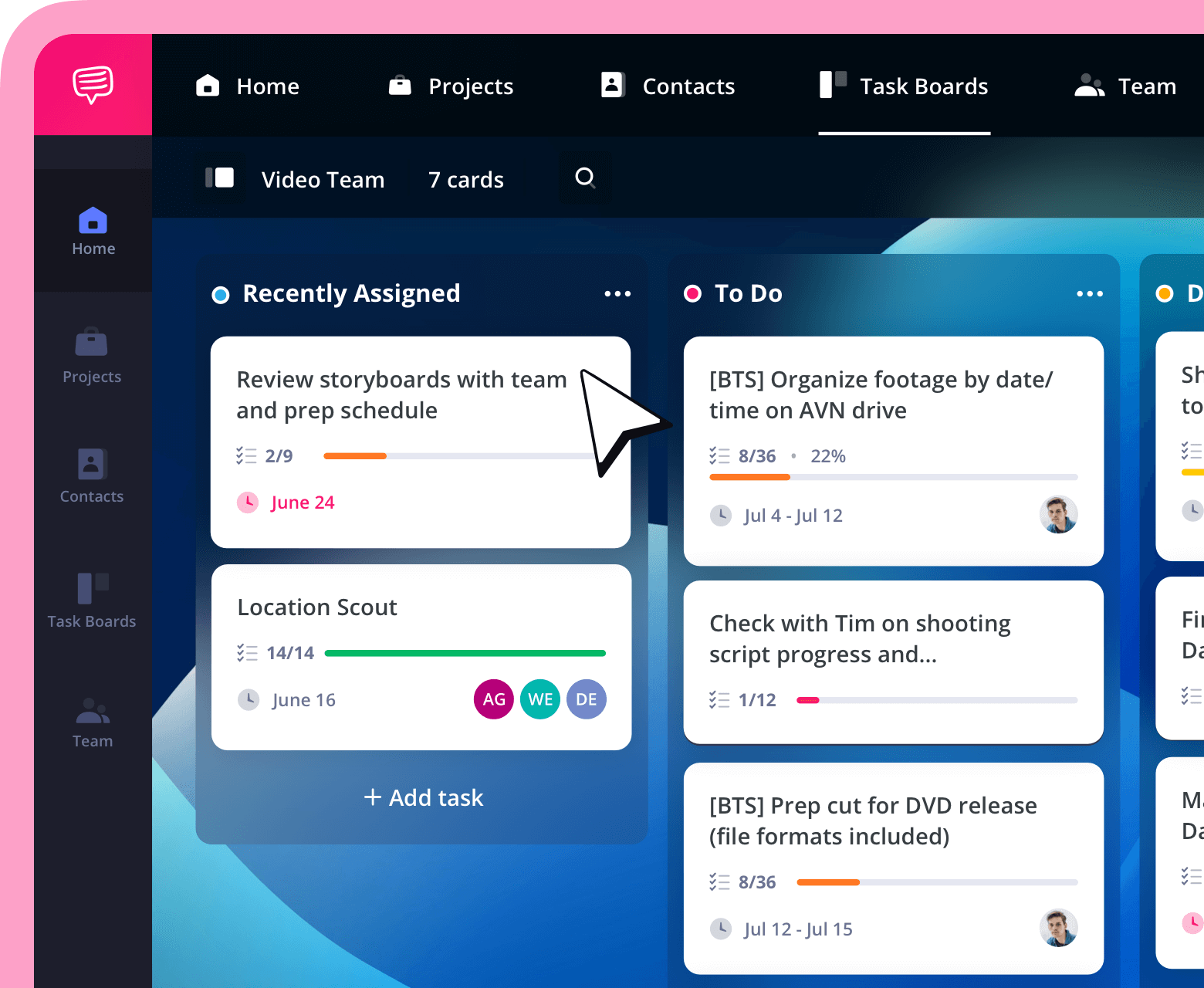
Assign a scribe or use a shared digital Task Board like StudioBinder to capture everything discussed in your brainstorm. Not only does making ideas visible helps participants build on each other’s contributions, but having something tangible to refer to means no one misses any great kernel of an idea, and can re-examine and stress-test the current ones.
Step 5: Evaluate and Refine
Keep in mind, this step should only come after idea generation ends. This can look like assessing the feasibility of the ideas presented, grouping ideas, eliminating duplicates, all to eventually identify the strongest options for your next steps.
Trusted by over 1M creatives
Task boards for production teams
Organize production tasks in boards, assign owners, and keep the team aligned.
What is brain storming
Types of brainstorming techniques
Okay, so you might already know what is brainstorming, but how about the techniques? Given that brainstorming is used across many different fields for many different objectives, there are a whole slew of methods and techniques to choose from. Brainstorming techniques allow you and your team to utilize structured ideation, which is a clear, specific process for facilitating better ideas more reliably.
When it comes to brainstorming techniques, one size does not fit all. Some methods suit group settings better, while others cater more to visual thinkers. Certain brainstorming techniques can even be used in conjunction with each other throughout your process to help you ideate, then evaluate the best solution for your project.
If you’re getting overwhelmed by all the options, never fear! We broke down popular brainstorming techniques in a blog post with step-by-step instructions and recommendations on what situations they suit best.
Related Posts
Brainstorming methods
Group vs individual brainstorming
The beauty of brainstorming is that anyone can do it. Nor is brainstorming exclusively a group activity, there are several scenarios where a solo brainstorm can be a rich and worthwhile exercise.
Each format of brainstorming has its own advantages and limitations depending on the goal, team dynamic, and timeline.
Feeling stuck? Refer to this table to determine whether group or individual brainstorming makes the most sense for you:
Factor | Group Brainstorming | Solo Brainstorming |
|---|---|---|
Idea Diversity | Multiple perspectives generate varied ideas | Moderate, limited to one perspective |
Speed of Idea Generation | Fast when energy is high | Can be slower but more focused |
Creativity Boost | Ideas build on each other | Deep, uninterrupted thinking possible |
Risk of Groupthink | Higher risk if poorly facilitated | No groupthink risk |
Psychological Safety | Depends on team culture | High, no fear of judgment |
Best For | Innovation workshops, team alignment, design thinking | Writing, complex problems, early-stage ideation |
Common Challenges | Dominant voices, idea blocking | Limited perspective, mental fatigue |
Ideal Structure | Facilitated session with rules | Timed solo session with idea capture |
You don’t always have to pick one or the other either when brainstorming, meaning that many high-performing teams combine both methods when tackling a new or particularly daunting challenge. Individuals generate ideas independently first, then bring them into a structured group session for expansion and refinement.
This hybrid approach works best when ideas are documented clearly from the start. Using a shared workspace like StudioBinder’s Docs so team members can submit ideas individually, then organize, expand, and refine them collaboratively in one centralized place.
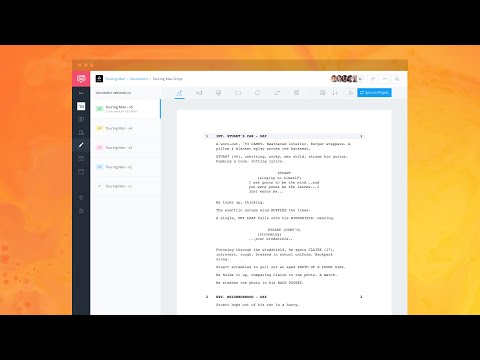
View the example below on using StudioBinder's Docs to organize your rapid ideation brainstorming session with teammates:
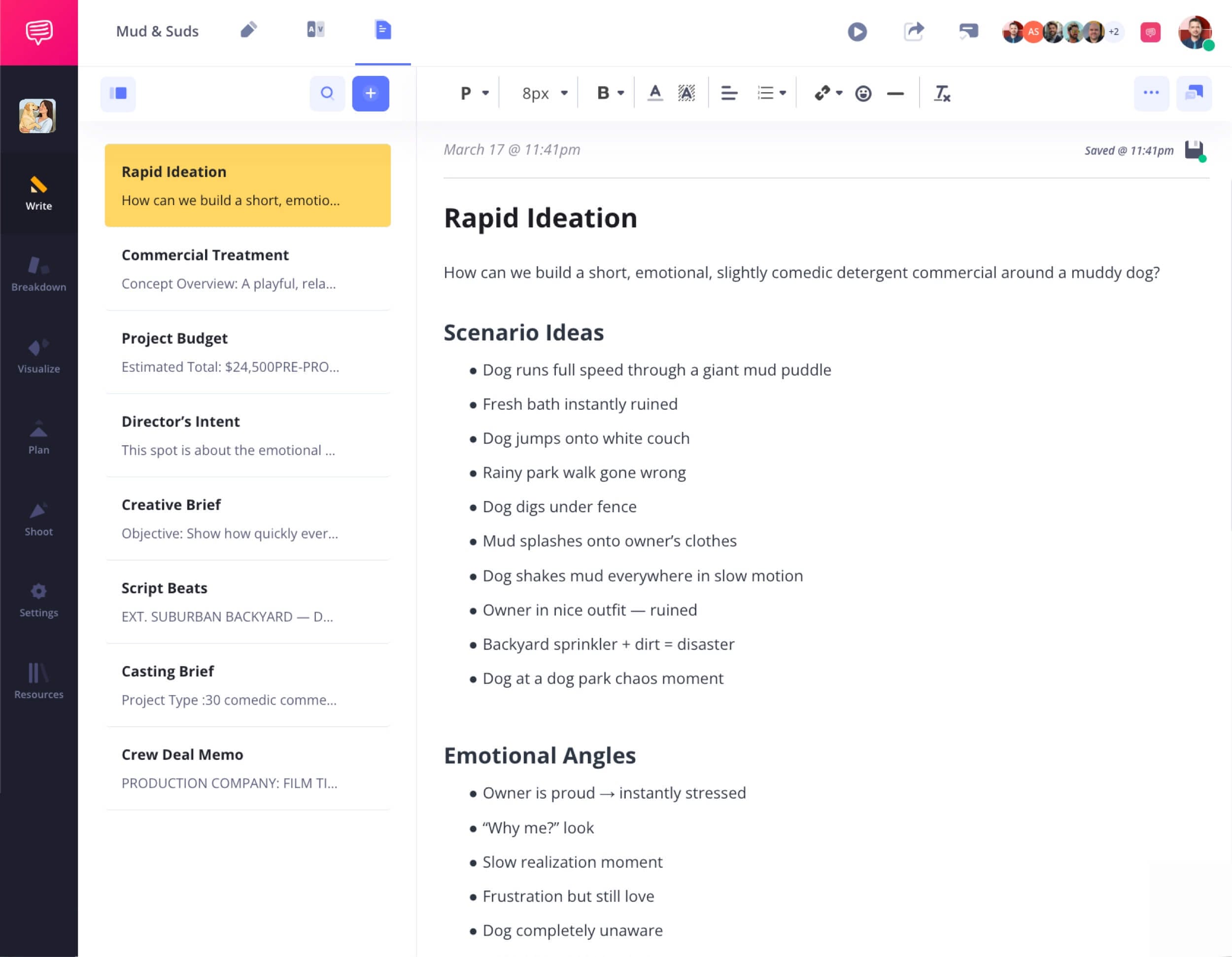
Brainstorming Example in StudioBinder • What is Brainstorming
Trusted by over 1M creatives
All your production docs, in one place
Give your team a workspace to write and share production notes, templates, and docs.
Related Posts
Brainstorming examples
4 real world brainstorming examples
Brainstorming isn’t just a helpful exercise when you’re stuck, it has tremendous real-world value. Believe it or not, brainstorming has been key in coming up with Oscar-winning stories, technological breakthroughs, and some of the biggest business ideas in society.
Take the wildly successful and beloved Walt Disney Animation Studios, for example. Their “Brain Trusts” sessions and calling upon group creativity shaped the development of Elsa’s character in the mega-hit Frozen. Learn more below:

Brainstorming Examples in Pixar
1. Business Example
AirBnb saved itself from going bust by brainstorming reasons why their company wasn’t growing. When they noticed that nearly all of the listing photos of their New York property had shoddy photography, they replaced the amateur photos with professional ones and doubled their weekly revenue with that one tweak. Using brainstorming in their innovation process aided them in becoming the tech behemoth we know today.
2. Classroom Example
During a Hack Ebola event at NYU, technologists, hackers, designers and experts within the university community came together to use design thinking and brainstorm ways to fight the Ebola epidemic. At the end of the two-day brainstorming session, participants built a scraper in order to provide metrics for analyzing further project submissions, and created a business plan that detailed the cost of a hypothetical UN-led, global health volunteer corps program to fight the disease.
3. Writing Example
Screenwriter Michael Arndt shared that initially, the writers of Toy Story 3 were stuck on how to save Woody and his friends from the incinerator in Act 3. Their breakthrough came from an exhaustive ideation process, which involved listing all the things in the character’s environment, eventually landing on the alien toys rescuing them via “The Claw”.
Brainstorming isn’t about finding the right idea immediately, it’s about exploring every possible one. Like the Toy Story 3 team, writers often start by listing everything in a scene’s environment and asking, “What can we use?” before narrowing in on a solution.
In this example from StudioBinder’s script outline tool, we see that process in action. Breaking down the problem, exploring possibilities, and letting the environment guide the breakthrough.
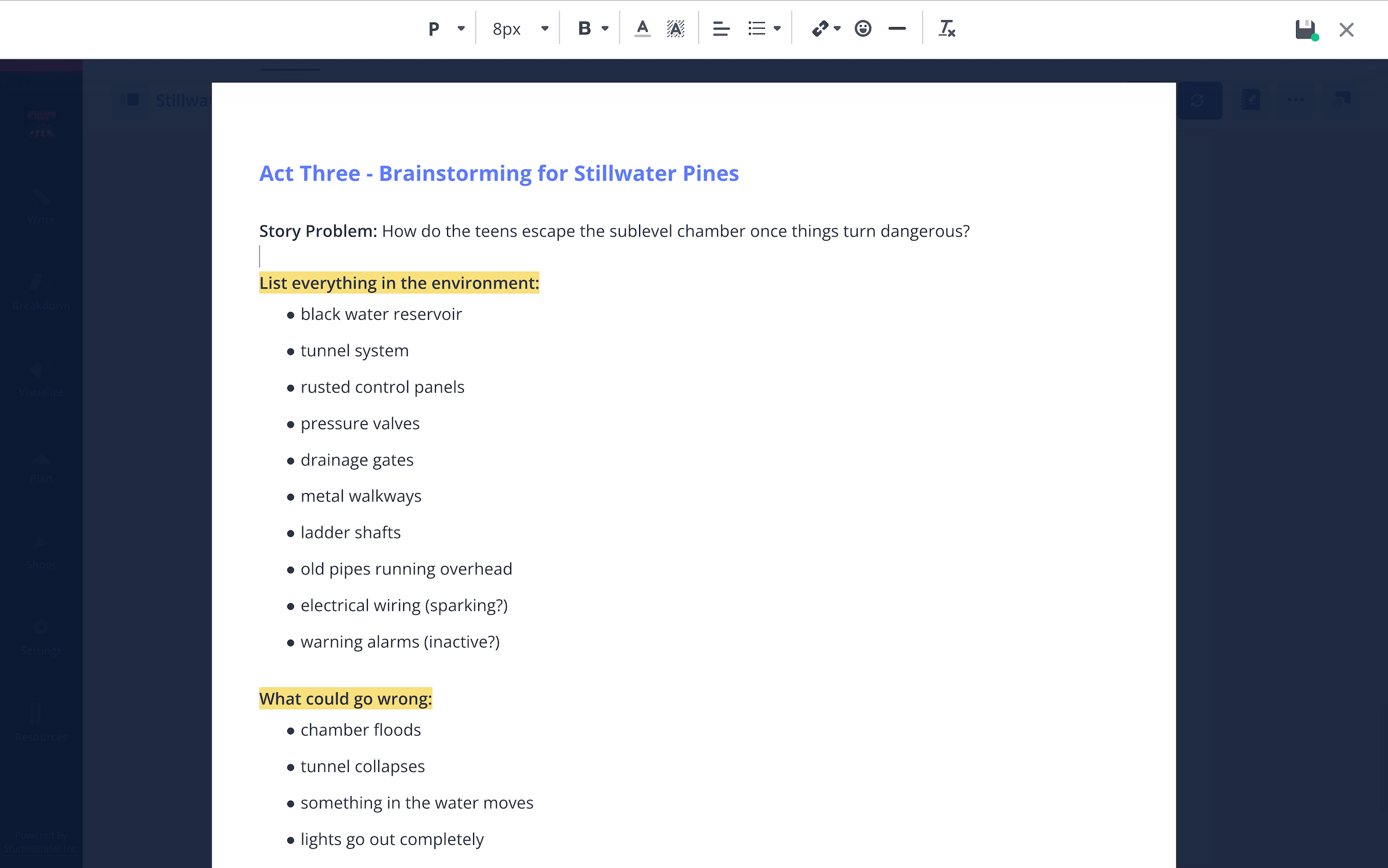
Script outline brainstorming session for screenplay in StudioBinder • What is Brainstorming
Once a strong idea emerges, it gets translated into the script itself. Often in a much cleaner, more focused form. What began as a messy list of possibilities becomes a clear, cinematic sequence on the page.
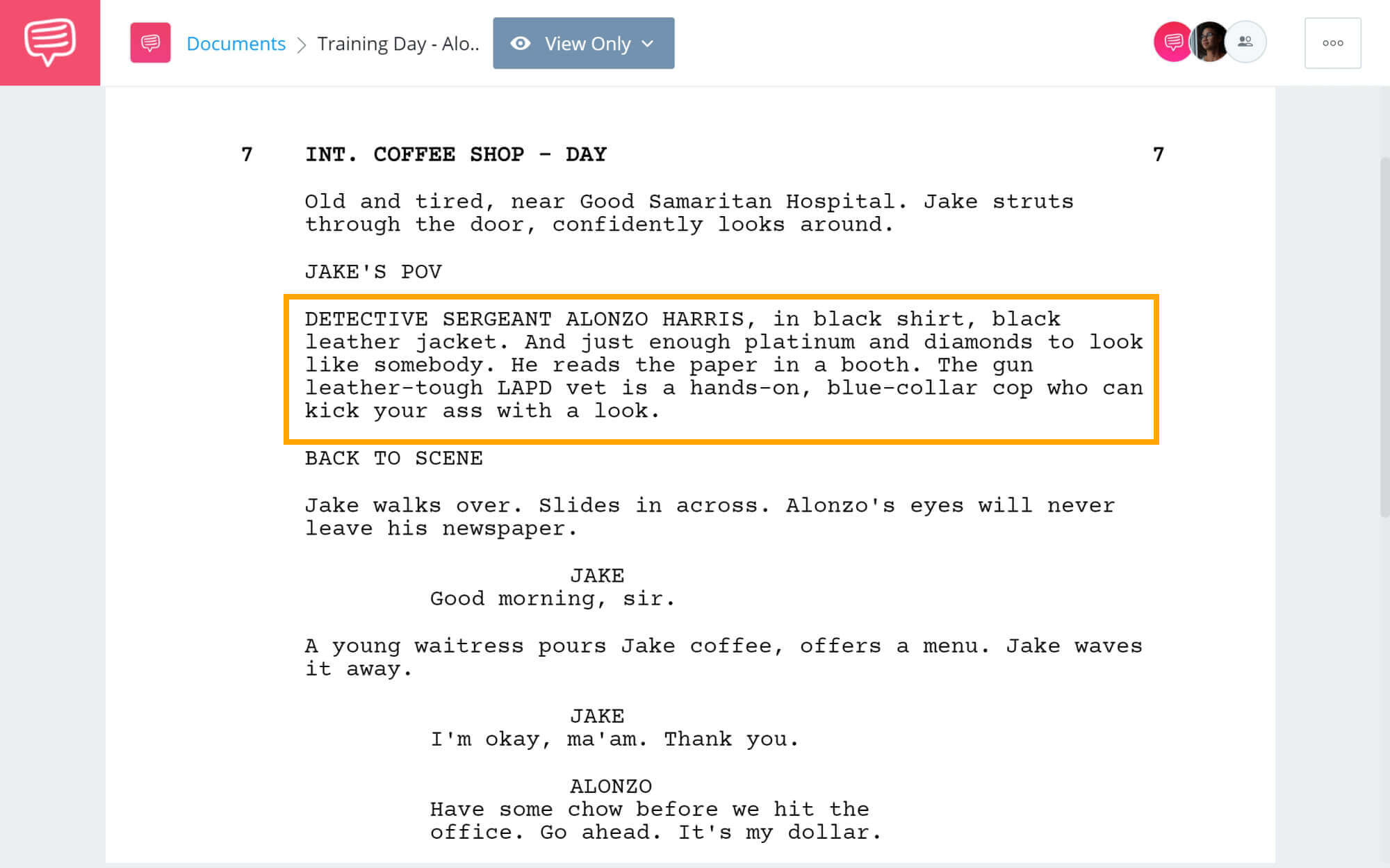
Here, the brainstormed concepts are distilled into the final Act Three scene, showing how ideation directly shapes the finished story.
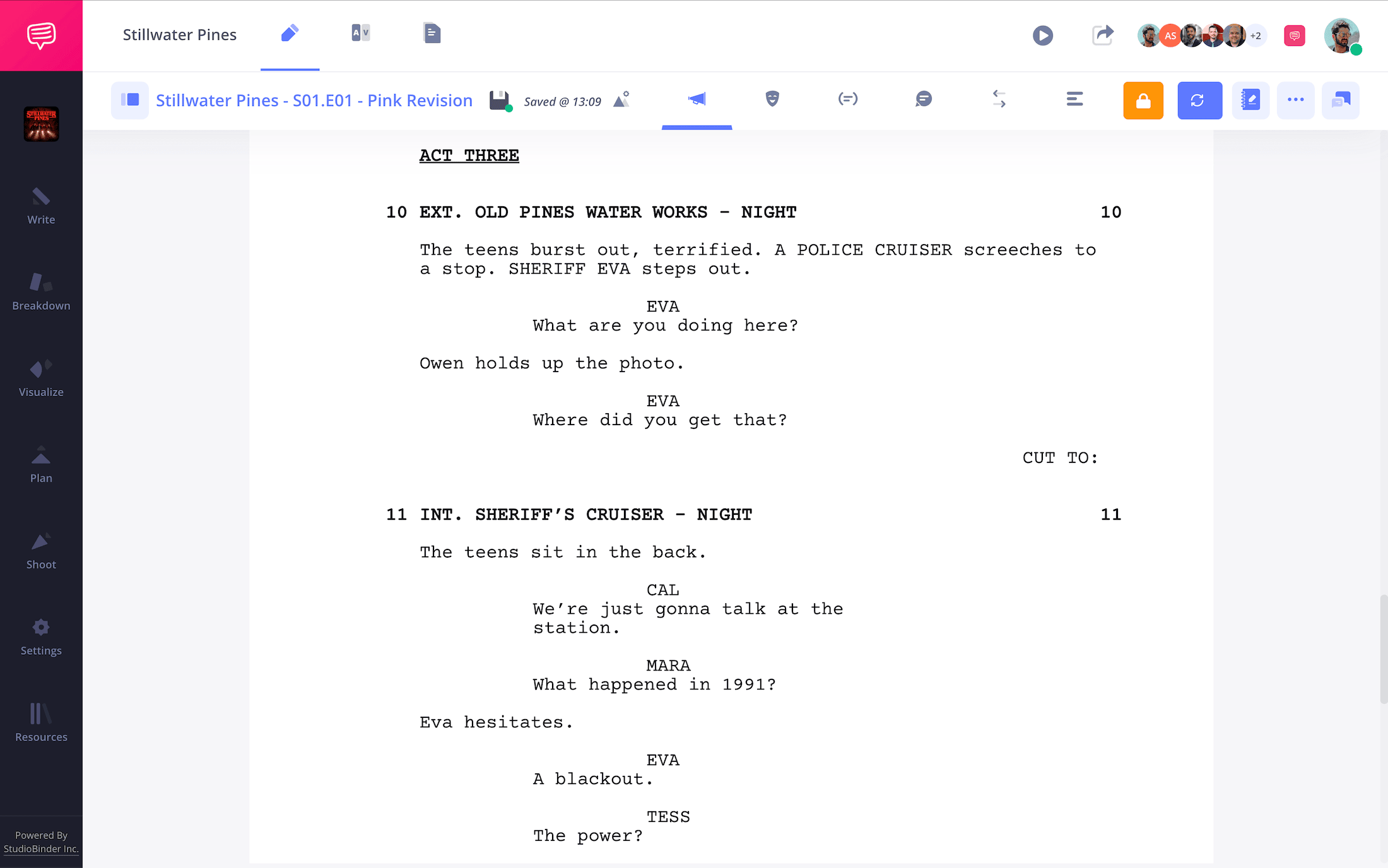
Sample screenplay example in StudioBinder • What is Brainstorming
4. Product Example
There’s a decent chance you’re reading this article on an iPhone. You can thank a brainstorm at Apple for that. In 2003, Engineer Duncan Kerr shared what he learned about multi-touch interfaces, the team used collaborative thinking to brainstorm what hardware they might build with the new type of interface, and four years later, the iPhone debuted and changed electronics forever.
Trusted by over 1M creatives
All your production docs, in one place
Give your team a workspace to write and share production notes, templates, and docs.
Related Posts
Key tools and templates for brainstorming:
Brainstorming tools and templates
Similar to the vast variety of brainstorming methods to choose from, there are also a wide range of tools at your disposal to optimize your brainstorming. Whether you’re working by yourself or in a group, consider incorporating these brainstorming tools and templates to boost your ideation process:
- Whiteboards (both physical and digital)
- Sticky notes
- Digital tools
- Online collaboration tools
- AI-supported brainstorming
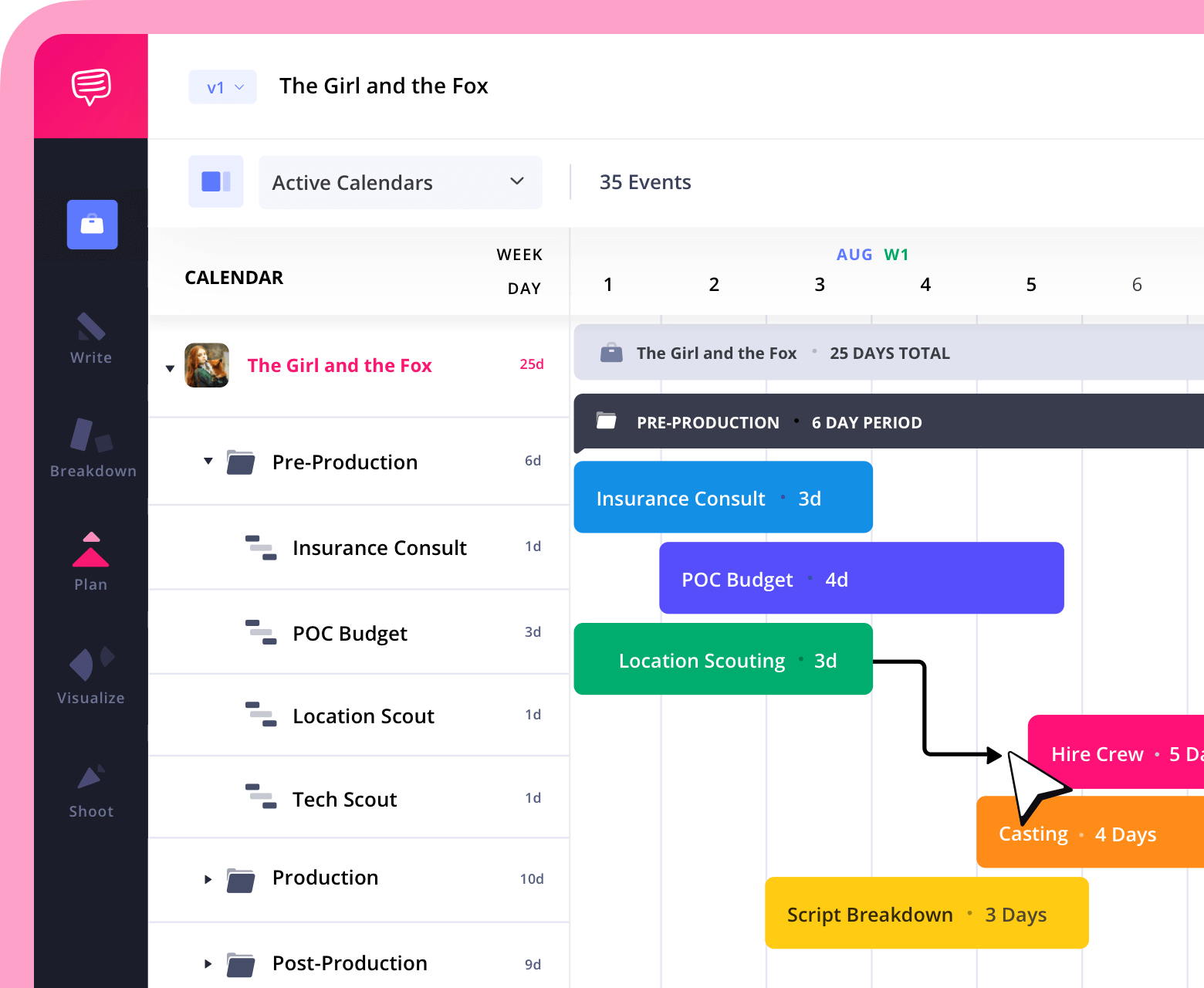
Explore StudioBinder’s free templates and online project collaboration tools to capture ideas in real time, organize them visually, and turn your best concepts into actionable next steps.
From first brainstorm to final execution, StudioBinder keeps your entire creative workflow in one place.
Trusted by over 1M creatives
Production timelines, visualized
Plan and share production milestones, tasks, and files to stay ahead of schedule.
Brainstorming 101
Brainstorming do’s and don’ts
Although it’s one of the most effective tools to generate ideas and solutions, a brainstorming session can go sideways surprisingly easily.

Brainstorm Ideas for Writers
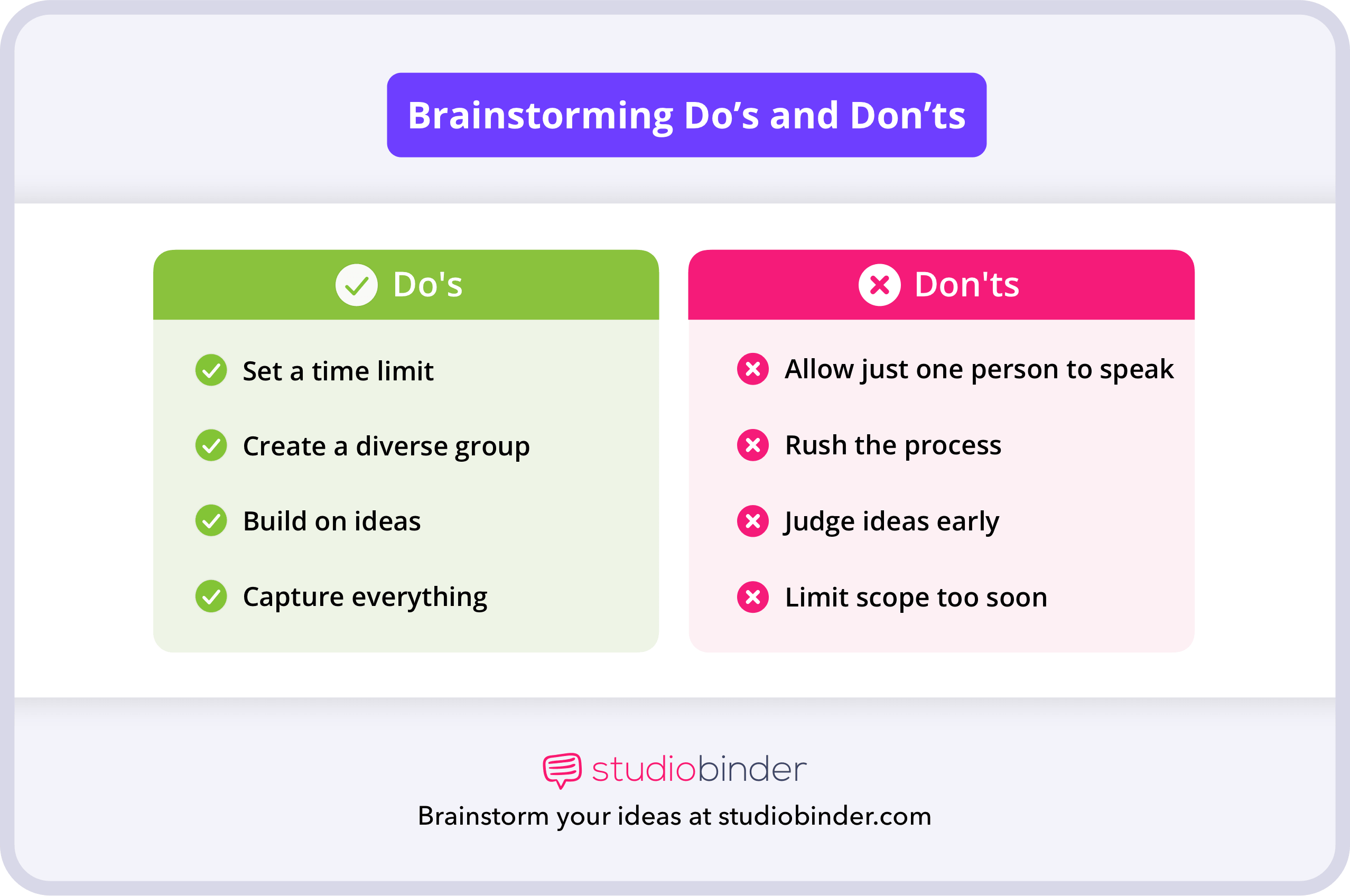
Follow these do’s and don’ts to maximize your results when you brainstorm, both by yourself and in a team setting:
Brainstorming Do's and Don'ts
Do: Clearly define the problem or opportunity
Clear constraints focus creativity. A well-defined problem produces stronger ideas than a vague one. Clearly stating what the group is here to solve or iterate on gives both yourself and your team focus and fosters more effective collaboration.
Specificity is also necessary. Instead of asking a writer’s room to brainstorm ideas for a “Third Plotpoints”, ask “How Would Character A Solve This Problem?” Sharing any necessary information or context before the brainstorm also helps to make the most of your session.
Do: Set a time limit
Giving yourself a time limit for brainstorming will help with organizing thoughts, aid in silencing one’s inner critic, and prevent folks from burning out.
The sweet spot for a brainstorming session typically falls between 15 to 60 minutes. You can also break this up by doing 5-10 minutes of individual rapid ideation and brainwriting, then using the rest of the allotted time to share ideas with the group.
Do: Create a diverse group
If your brainstorming session is made up of solely one type of person, for instance, all producers, executives, or writers brainstorming ideas to solve a production problem, you’re likely not going to generate many new ideas. Plus, the proposed solution may have some pretty glaring blindspots when it gets passed along to other departments.
That’s why it’s paramount to curate a group of diverse perspectives when putting together a problem solving strategy to facilitate collaborative thinking. This will allow others to catch problems early, and for a multi-faceted approach to your problem or opportunity. Smaller groups move faster. An ideal size is typically 5–8 participants.
Do: Visualize ideas and relationships
Part of what makes brainstorming so effective and necessary is that it forces us to get our ideas out of our heads and in front of others. Having a designated “scribe” during a brainstorm is always a good idea to keep track of and organize the ideas that come from the session.
There are several brainstorming tools and techniques one can use to structure their brainstorm, like affinity mapping which groups ideas or data into patterns or starbusting, which uses a six-pointed star and the questions who, what, when, where, why, and how to generate questions to thoroughly explore a topic.
Don’t: Allow just one person to speak
It’s common in a brainstorming session for the senior or more extroverted members to dominate the discussion while the introverted or junior members never get a word in. Appointing a facilitator for the brainstorm who can moderate the conversation or starting with individual brainwriting prevents this trap.
Don’t: Leave without actionable next steps
Nothing lowers morale quicker than the feeling of time wasted. Therefore, budgeting time at the end of a brainstorming session to evaluate what works best, then assigning specific tasks to team members is critical. Making next steps clear, actionable, and accountable for yourself or your team is what transforms the deluge of ideas in a brainstorm into your next great story, solution, or opportunity.
Brainstorming is one of the most valuable tools a team has for collaborating and problem solving. It’s easy to get lost and overwhelmed when brainstorming, which is why adhering to Osborn’s four core principles and following these do’s and dont’s is essential to the process. When done right, brainstorming lets you and your team come up with new ideas and solutions, but increase the quality of your output as well as arrive at breakthroughs more quickly, and can even improve communication.
Trusted by over 1M creatives
AV scripts with built-in timing
Write in two-column format, track runtime, and share with version control
Frequently Asked Questions
Common questions about brainstorming
Start with a clearly defined problem, set a time limit, and defer judgment, and encourage wild ideas during your session. Capture every idea before moving into evaluation and refinement. For teams, it can be a helpful start with a few minutes of silent ideation so everyone contributes.
Creating a safe, supportive environment is critical for team collaboration. If people expect criticism, they’ll self-censor and idea flow will collapse. A facilitator and clear rules help keep the session open and productive.
Defer judgment, encourage wild ideas, build on others’ ideas, and focus on quantity first. These rules keep creativity flowing before the group shifts into selecting the best options.
Reverse brainstorming is a classic example: instead of asking “How do we fix this?”, you ask “How could we make it worse?” That perspective exposes root problems and makes it easier to reverse-engineer solutions.
UP NEXT
The most effective brainstorming techniques
Understanding the fundamentals is just the beginning. The real impact comes from choosing the right structure for your specific goal. Different challenges call for different approaches — whether you need rapid idea generation, deeper analysis, or collaborative expansion.
Some of the most effective brainstorming methods include:
- Mind Mapping
- Brainwriting
- SCAMPER method
- Reverse Brainstorming
- Round Robin Brainstorming
- Rapid Ideation
Each method is designed to unlock creativity in a slightly different way. Some work best for team collaboration, while others are ideal for solo deep thinking.
Ready to go deeper? Learn exactly how each technique works and when to use it in your work.
Up Next: Brainstorming Techniques →